




Having CI/CD does not make an organization mature at DevOps. Neither does Kubernetes, Terraform, or moving infrastructure to the cloud. A company can automate deployments and still depend on manual approvals. It can run Kubernetes and still struggle with incidents. It can have dozens of dashboards without knowing which issues actually affect customers. That is what a DevOps maturity model helps uncover. Instead of asking “Do we do DevOps?”, ask:
How consistently can your organization deliver, operate, recover, and improve software at scale?
This guide provides a practical DevOps maturity framework, a five-level assessment model, and an improvement roadmap for organizations that want to move from manual operations toward more reliable, measurable, and scalable delivery.
A DevOps maturity model is a framework for evaluating how effectively an organization applies DevOps practices across software delivery, infrastructure, automation, observability, security, scalability, and team ownership. Its purpose is not to assign a badge or maturity score for its own sake. It should answer three questions:
Where are we now?
What is holding us back?
What should we improve next?
This matters because DevOps maturity is rarely uniform. One team may have mature CI/CD pipelines but still provision infrastructure manually. Another may use Infrastructure as Code but lack reliable observability or automated security controls. A useful DevOps maturity assessment therefore evaluates individual capabilities rather than assigning one overall score to the whole organization.
At a small scale, inefficient processes can remain manageable. One engineer can configure an environment manually. A team can coordinate releases through Slack. An experienced operations engineer may know how to recover a failed service without a documented runbook. At enterprise scale, those shortcuts become dependencies.
Low DevOps maturity often appears as business problems:
The goal of DevOps transformation is not automation for its own sake. It is to create a delivery model that allows teams to move faster without sacrificing reliability, security, or scalability. DORA's software delivery research reflects the same principle: high-performing teams do not simply optimize for speed. They improve throughput while controlling instability and recovery performance. For engineering leaders, the key question becomes:
Can the way your teams build and operate software today still work when the business becomes significantly larger?
There is no single universal DevOps maturity assessment model, but seven areas provide a useful baseline.
Assess:
The question is not whether a pipeline exists. It is whether that pipeline enables safe, repeatable delivery.
Assess:
At higher maturity, infrastructure becomes reproducible, reviewable, and easier to scale.
Evaluate automation across:
A simple test is:
What happens when traffic doubles, a deployment fails, or a new environment is needed?
If the answer depends on someone manually executing a sequence of steps, there is still significant automation potential.
Assess:
Higher maturity means moving from reactive monitoring toward proactive reliability management.
Assess:
At lower maturity, security is a gate before production. At higher maturity, it becomes part of the delivery pipeline.
Assess:
A mature environment should scale predictably without requiring constant manual intervention.
Assess whether teams:
At higher maturity, platform engineering and self-service capabilities often become more relevant.
The following model is a practical DevOps maturity framework rather than a universal industry standard. Organizations may sit at different levels across different capabilities.
Typical characteristics:
The main objective is to make critical processes repeatable. Start by documenting workflows, standardizing environments, and automating the highest-risk manual steps.
Typical characteristics:
The focus should be on reducing inconsistency. Processes that work for one team should become repeatable across products and environments.
Typical characteristics:
Automation becomes the default. The objective is to remove manual dependencies from the critical delivery path.
At this level, teams understand not only whether processes work, but how well they work.
Typical characteristics:
The goal is to use operational data to identify the next constraint. Instead of asking “What should we automate next?”, teams can ask:
“Which problem currently has the greatest impact on delivery, reliability, or business performance?”
The highest level is not a final state. It is a continuous improvement capability.
Typical characteristics:
At this stage, organizations focus on improving business outcomes, not simply adopting more DevOps tools.
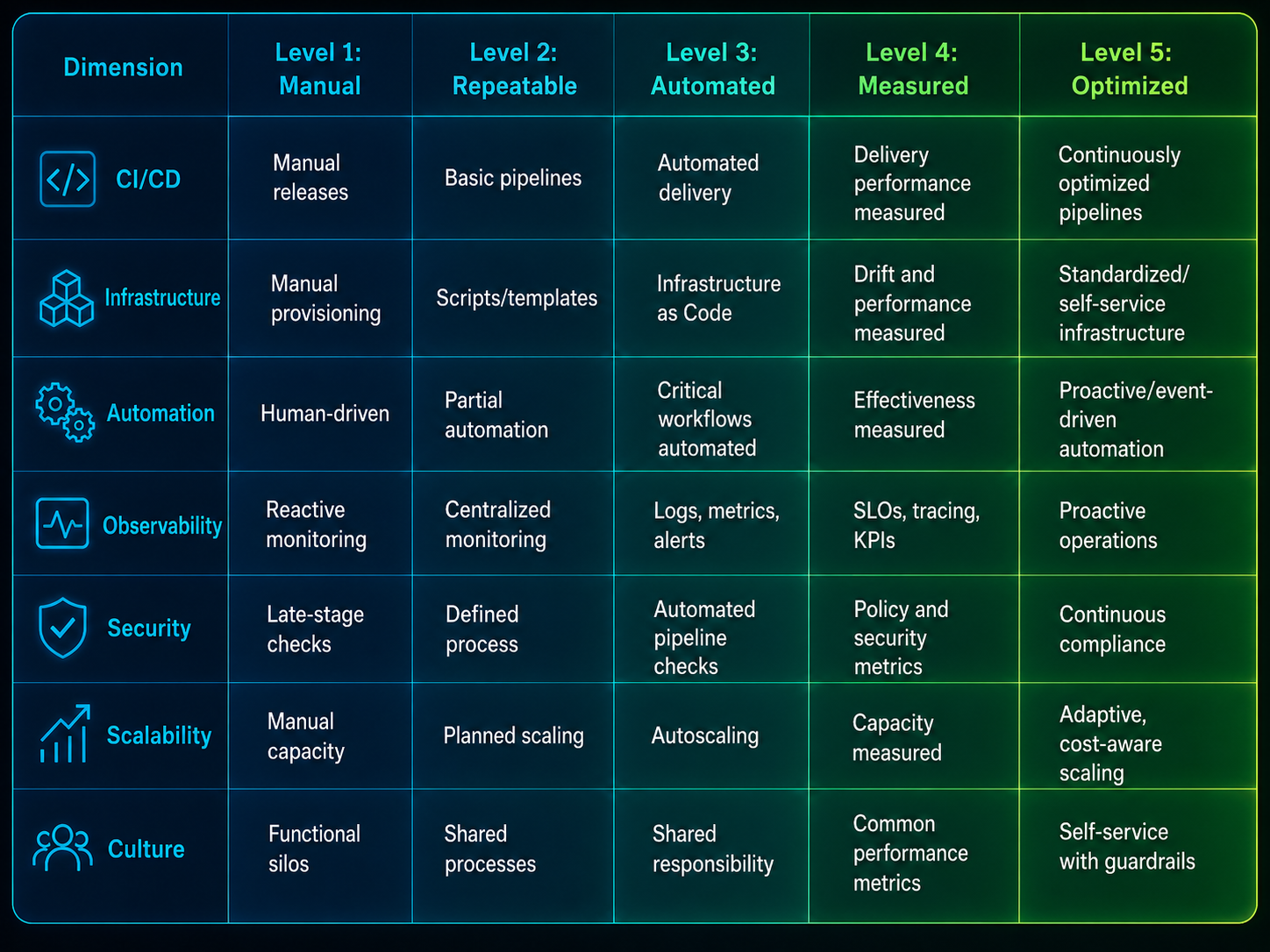
Do not average the columns and declare the organization “Level 3.” A company may be Level 4 in CI/CD, Level 3 in infrastructure, and Level 2 in security.
That unevenness is exactly what the DevOps maturity matrix should reveal.
A useful assessment starts with evidence, not perception.
Follow one real change from commit to production:
Commit → Build → Test → Approval → Provision → Deploy → Observe → Recover
Identify:
2. Establish a Baseline
Track a focused set of metrics.
Start with DORA's current software delivery metrics:
Then add business-relevant operational measures such as:
For example:
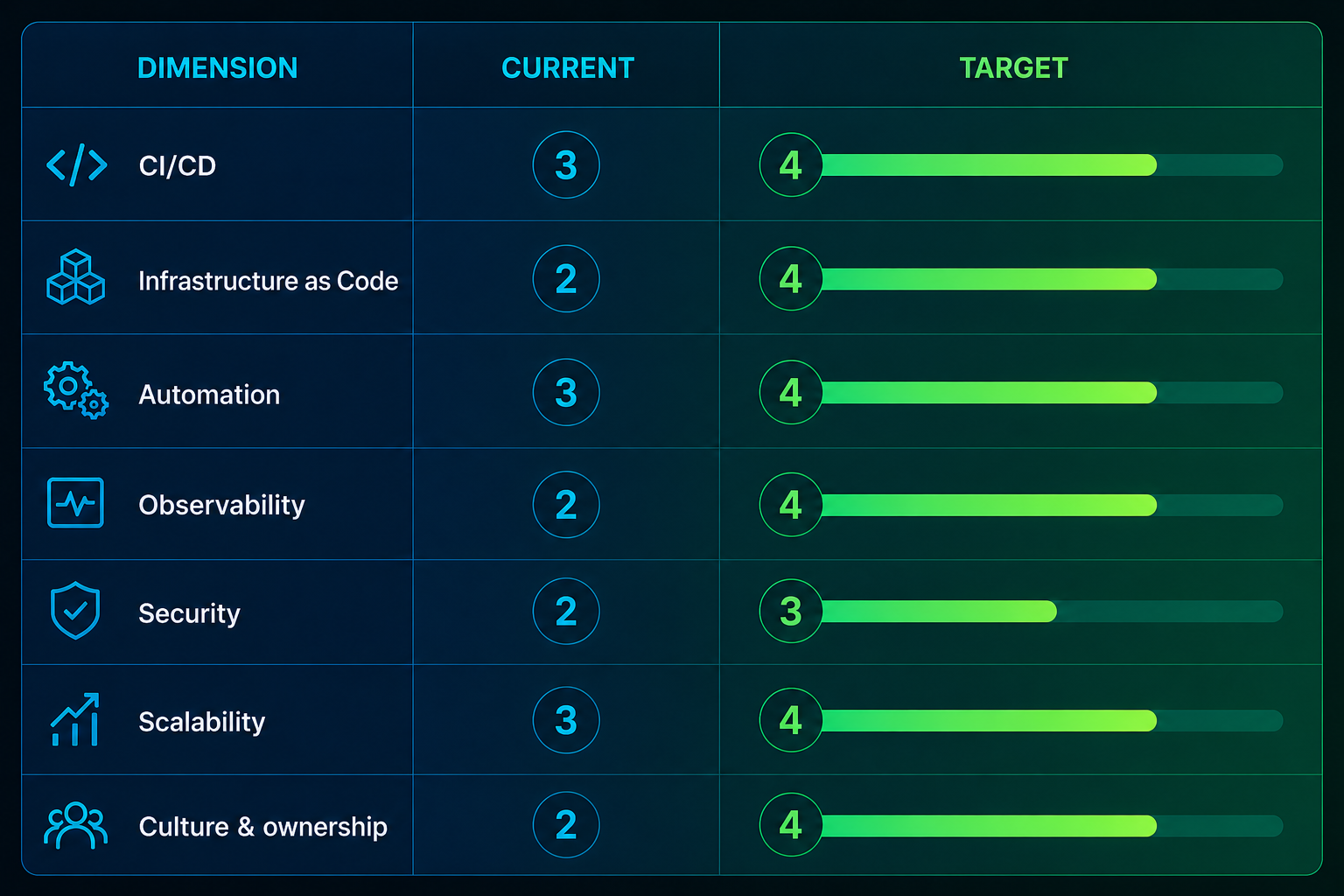
This creates a much more useful picture than one overall maturity score.
Do not automatically prioritize the lowest score. Look for the capability that causes the largest operational or business impact.
For example:
Do not automatically prioritize the lowest score.
Look for the capability that causes the largest operational or business impact.
For example:
Manual infrastructure provisioning→ inconsistent environments
→ configuration errors
→ slower releases.
Or:
Weak observability→ slow diagnosis
→ longer incidents
→ missed SLAs.
The initiative should not be:
“Let's implement Kubernetes.”
It should be:
“Environment provisioning is slow and inconsistent. We need reproducible infrastructure and fewer manual dependencies.”
Technology selection comes after the constraint is understood.
A practical DevOps maturity roadmap can follow five phases:
Understand architecture, workflows, ownership, bottlenecks, and current delivery performance.
Outcome: current-state maturity matrix.
Standardize environments, document critical processes, improve ownership, and establish reliable monitoring.
Outcome: predictable delivery foundation.
Focus on:
Outcome: fewer manual dependencies and faster delivery.
Introduce:
Outcome: measurable engineering performance.
Improve:
Outcome: continuous improvement aligned with business needs. The important point is simple: Tooling supports maturity. It does not create it.
A maturity model matters only if it improves real outcomes. OpsWorks has seen that across different enterprise environments. For Winnow, infrastructure improvements contributed to a 75% reduction in downtime. For a large European financial services provider serving more than 16 million customers across 10+ countries, DevOps transformation work resulted in a reported 3× scalability increase. And for Syndigo, where infrastructure spending had reached up to $1 million per month, infrastructure and workload optimization resulted in 92% cost optimization. These outcomes are different: reliability, scalability, and efficiency. That is the point. DevOps maturity is not one metric. It is the organization's ability to improve the engineering capabilities that currently constrain the business.
An internal assessment may be enough when architecture is relatively simple and engineering leadership already has reliable performance data. External assessment becomes more valuable when:
OpsWorks approaches DevOps Assessment by reviewing infrastructure, deployment practices, and operational bottlenecks before defining a transformation path. Its DevOps Transformation capabilities include CI/CD implementation, Infrastructure as Code, monitoring, scalability analysis, performance optimization, autoscaling, and containerization. The sequence matters: Assess first. Transform second.
Use this DevOps maturity checklist as a quick first-pass assessment:
If several answers are “no” or “it depends on the team,” the next step should not automatically be another tool. It should be understanding which gaps have the greatest impact.
The goal of a DevOps maturity model is not to reach Level 5 and declare the transformation complete. Infrastructure changes. Products grow. Teams reorganize. Security requirements evolve. A mature organization is not one that has automated everything.
It is one that can:
identify constraints → measure their impact → improve the system → repeat
For organizations where delivery complexity has outgrown incremental fixes, a structured DevOps assessment can provide the baseline for deciding what should be standardized, automated, measured, or redesigned next.
Assess Your DevOps Maturity → Talk to OpsWorks
A DevOps maturity model is a framework for evaluating DevOps practices across software delivery, infrastructure, automation, observability, security, scalability, and team ownership. It helps identify the current state and prioritize improvements.
In this framework, the five DevOps maturity levels are Manual, Repeatable, Automated, Measured, and Optimized.
A DevOps maturity assessment evaluates current software delivery and operational practices to identify bottlenecks, automation gaps, reliability issues, and improvement opportunities.
DevOps maturity can be measured through delivery, reliability, infrastructure, automation, security, and organizational metrics. DORA metrics are a useful starting point for software delivery performance.
A DevOps maturity matrix maps individual capabilities against defined maturity levels. It helps organizations identify uneven maturity and determine where investment should go next.


Subscribe to our newsletter and get the latest insights that help you stay ahead of the curve.

© 2017-2025 All rights are reserved


