




What would your business look like if your team shipped faster? If your apps were more secure? If your developers were genuinely happier at work? These are not hypothetical situations. C-level executives who built strong DevOps practices report these results.
The challenge is building that team. Usually, decision-makers have three options. The first one is hiring in-house, which can be slow, complicated, and expensive. The second one is going fully offshore, which often means time zone friction and communication gaps. And that’s where the third option, namely nearshoring, is the most beneficial one, because it sits right in the middle. You get qualified engineers, overlapping working hours, and a much smoother collaboration from day one.
But it doesn’t mean every nearshoring development company is suitable for your project. This guide gives you a clear picture of what DevOps transformation can do for your business, a list of the top 10 DevOps nearshoring companies in 2026, and a practical checklist for choosing the right partner for your specific project.
Understanding DevOps relevance to the business means recognizing that your partners do not just maintain infrastructure. They design it, automate it, secure it, and optimize its operational costs. The scope is wide, covering every part of how your product is built and delivered.
Here is what that looks like in practice.
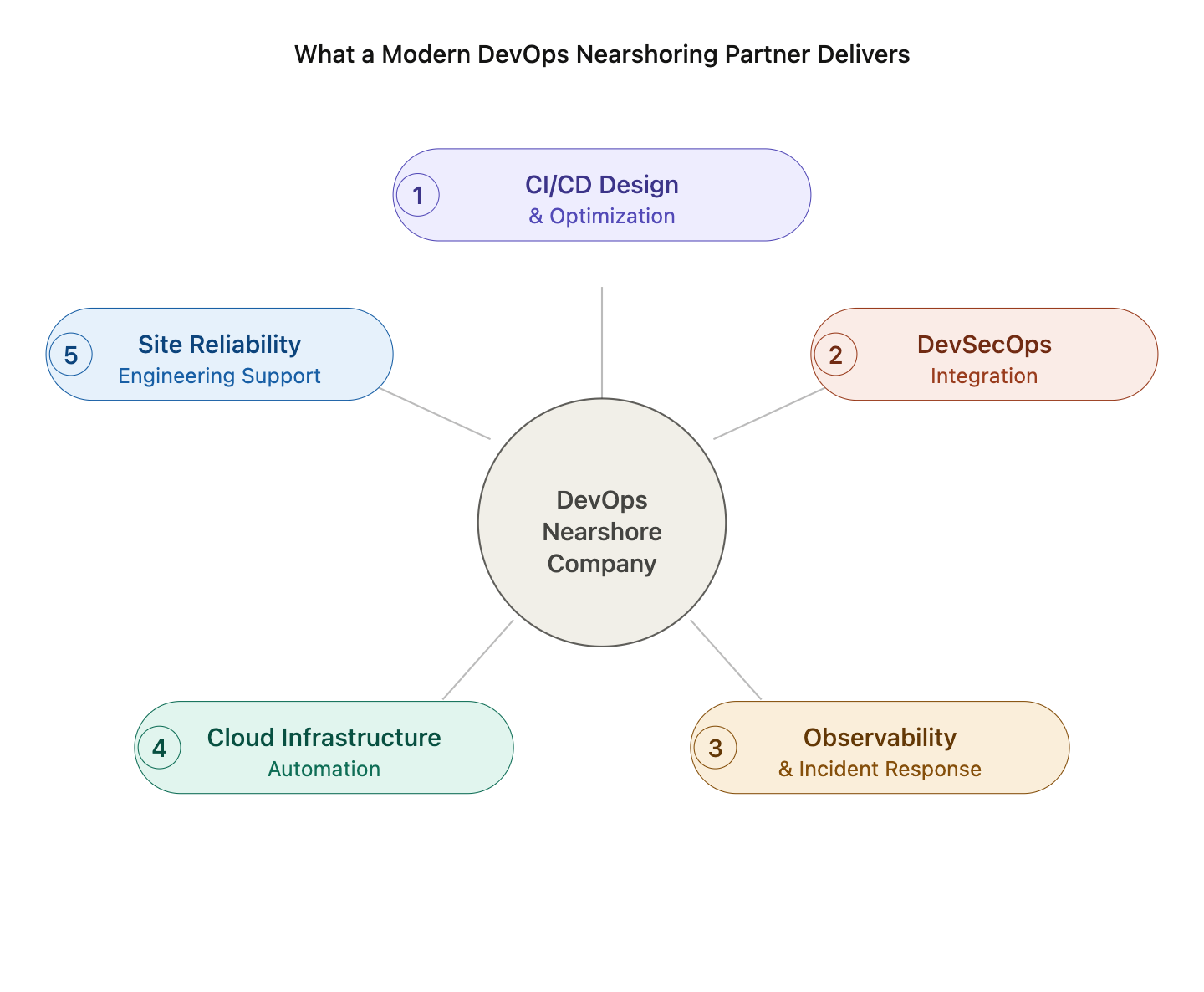
Slow, manual release cycles slow your time to market, increase the cost of bug fixes, and turn every release into a high-stakes event where a single bad commit can take the whole system down.
With a continuous integration and delivery (CI/CD) approach, the process looks different: every code commit is instantly integrated into the test environment, so teams know immediately whether the system operates correctly or where the code needs improvement. A nearshore DevOps team designs and maintains CI/CD pipelines so your developers stop worrying about releases and start shipping with confidence.
Paying for idle infrastructure is one of the most common and avoidable costs in tech. A strong DevOps partner migrates your workloads to the cloud and builds automation that scales capacity up when you need it and down when you do not. As a result, you pay for what you use.
Site reliability engineering (SRE) brings a software mindset to operations. SRE teams set clear reliability targets, build automated systems to meet them, and respond quickly when something breaks. Most engineering teams only start thinking about reliability after something goes seriously wrong. A production outage, a missed SLA, an angry enterprise client. By then, the damage is already done. A proactive SRE partner builds the systems and processes that prevent you from reaching that point.
Security is no longer a final checkpoint before release. Modern DevOps nearshore partners offer security and compliance services as a core part of their delivery model. They weave security checks directly into your development pipeline, catching vulnerabilities early when they are cheap to fix.
A mature DevOps partner builds full observability across your stack: logs, metrics, and traces that tell you exactly what is happening and why. When something breaks, they respond fast, minimize downtime, and document what went wrong so it does not happen again.
How do you know if a DevOps team is a strong one before signing the contract? There are a few things that set the best nearshore DevOps teams apart. Pay attention to them at the earliest stages of your research.
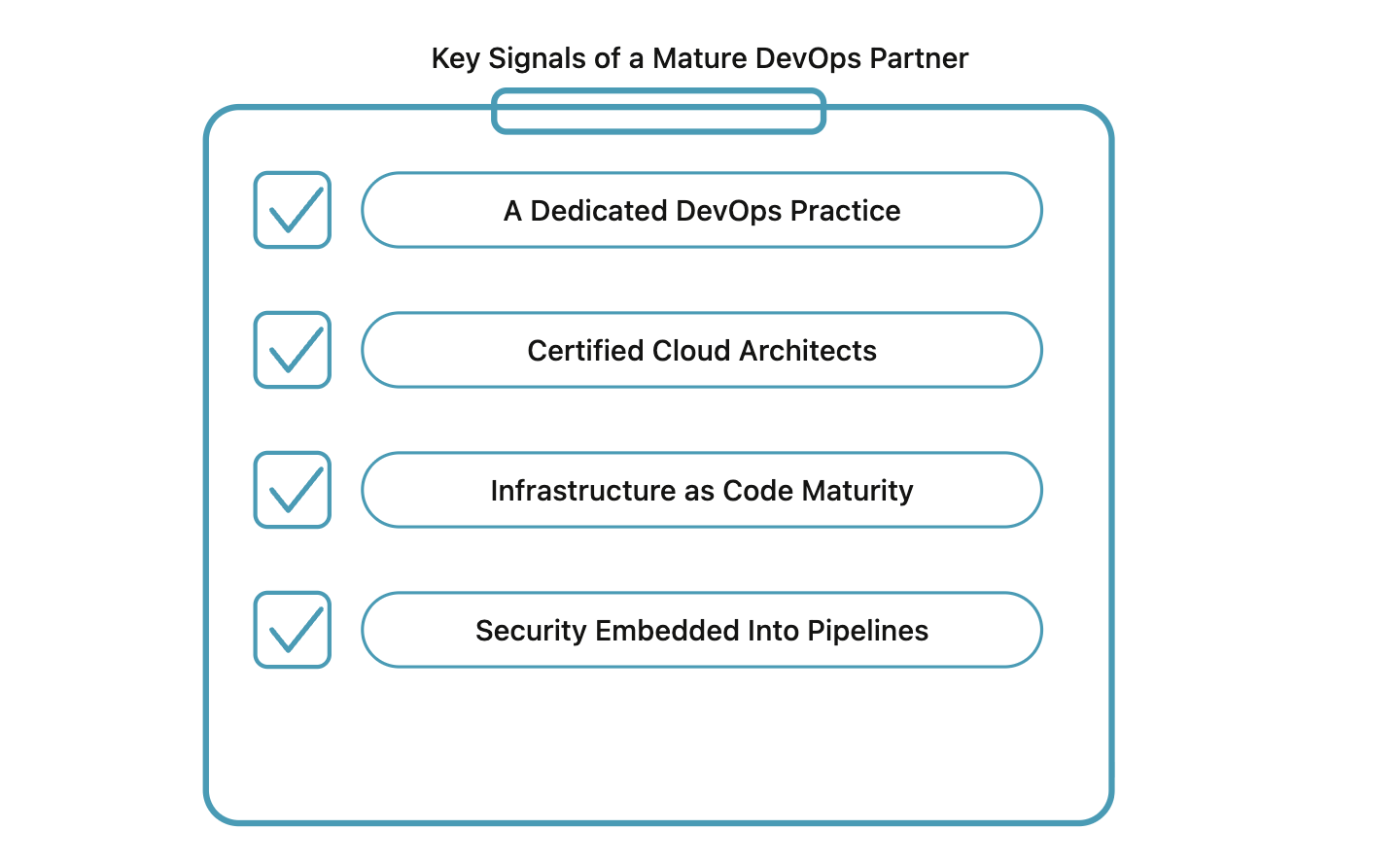
A serious nearshore partner runs DevOps as a standalone discipline, not a side responsibility shared among developers. This means a dedicated team with its own processes, tooling standards, and delivery ownership.
In practice, you can spot this quickly. When you land on their website, do they position DevOps transformation as a core service? Do they publish case studies that show measurable DevOps outcomes: faster release cycles, reduced downtime, infrastructure cost savings? If DevOps is genuinely their strength, they will make it obvious.
Cloud adoption is an ongoing engineering discipline that requires deep expertise in how cloud platforms behave at scale. Look for partners whose architects hold active certifications across AWS, Azure, or Google Cloud.
Check their team page and LinkedIn profiles. Do you see AWS, Azure, or GCP certifications listed? Do their engineers update their profiles regularly with new credentials? A company that invests in keeping its team certified takes technical excellence seriously.
A mature DevOps partner does not manually provision servers. Every environment, configuration, and scaling rule lives in version-controlled code. This means faster onboarding, consistent environments, and infrastructure that your whole team can review, audit, and improve over time.
Check their GitHub profile if it is public. Do they contribute to open source Infrastructure as Code (IaC) projects? Do their blog posts and case studies reference Terraform, Pulumi, or similar tools in concrete, specific ways? Depth of content usually reflects depth of expertise.
A mature team embeds security scanning, dependency checks, and compliance validation directly into the CI/CD pipeline. Every commit gets checked. Every deployment meets a defined security standard before it reaches production.
When reading about a potential partner, look for how they describe their pipeline setup. Do they mention DevSecOps as part of their process by default, or only as a separate, optional service? Check whether they hold relevant compliance certifications such as ISO 27001 or SOC 2.
You now know what mature DevOps delivery looks like and what to check during your research. The companies below meet those standards. Each one brings a distinct set of strengths, so rather than ranking them by score, we describe what makes each worth considering and who they are best suited for. –
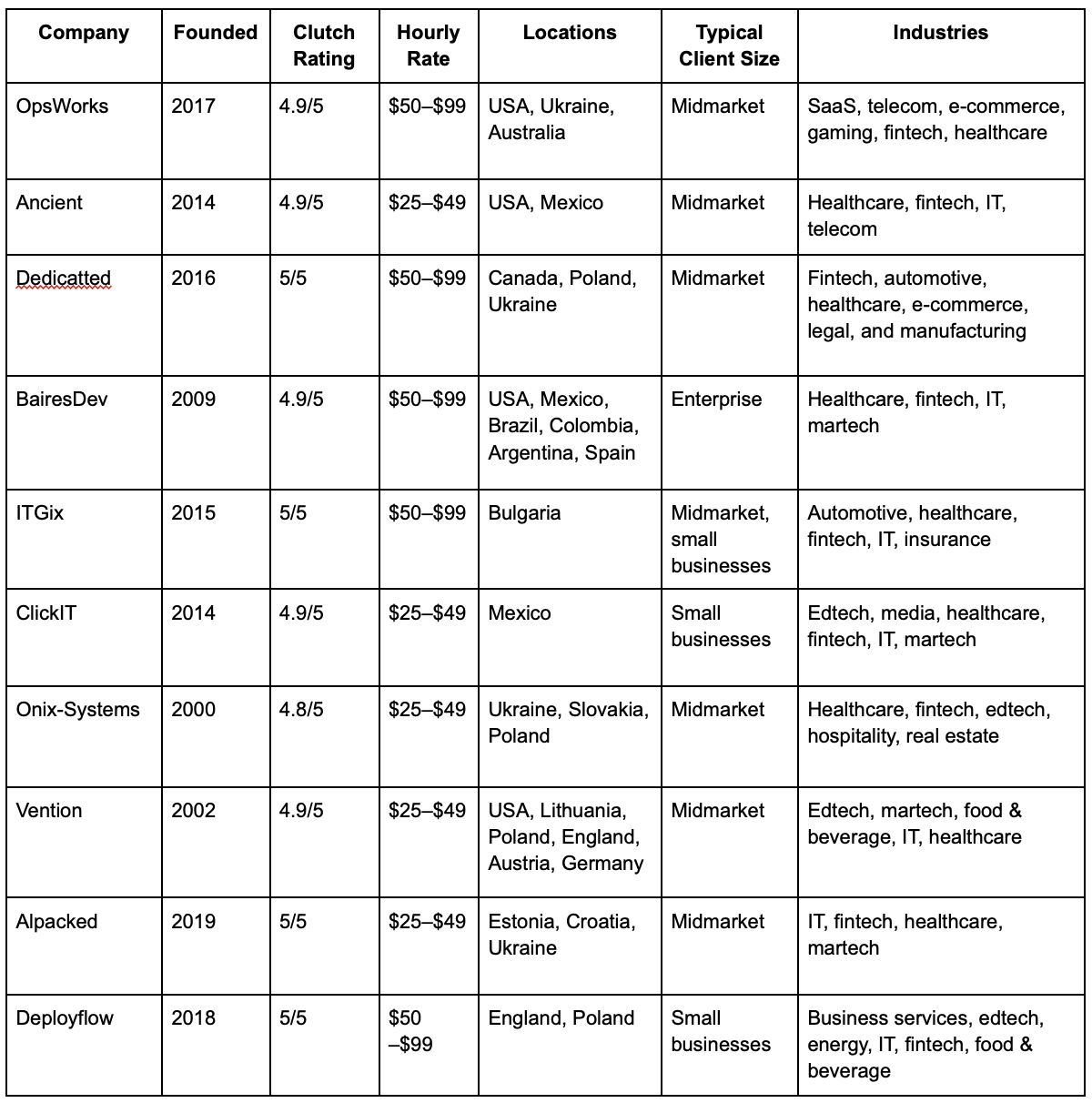
Clutch Rating: 4.9/5
Hourly rate: $50 - $99
Locations: USA, Australia, Ukraine
Typical client size: Midmarket
Industries served: SaaS, telecom, e-commerce, gaming, fintech, healthcare
The entire company focuses exclusively on DevOps and Cloud engineering, which means every engineer, every certification, and every case study point is aligned.
Founded in Kyiv with offices in Florida and Australia, the team has grown to 50+ engineers and completed 100+ projects across the US and EU markets. Their Upwork profile has a 100% success rate, and their Clutch rating is 4.9 out of 5.
OpsWorks is one of the top DevOps nearshoring companies holding AWS Advanced Tier Services Partner status, AWS EKS Delivery Partner designation, and AWS Well-Architected Program Partner status. Their experience is also backed by 50+ AWS certifications spanning Specialty, Professional, and Associate levels.
Beyond AWS, the team holds active certifications in Kubernetes (CKA, CKS, CKAD), HashiCorp Terraform and Vault, Red Hat, and Google Cloud, among others. The company itself is ISO 27001 certified.
What genuinely sets OpsWorks apart from most DevOps nearshoring companies is its AI-driven delivery model. Ahead of full security coverage and deep technical expertise, the tooling and agents run across every engagement by default. The team uses AI to accelerate project delivery, catch issues before they reach production, and cut down manual operations overhead.
Their case study results are consistently specific and measurable:
If your infrastructure costs are climbing or your release cycles have stalled, OpsWorks is worth a direct conversation.
Clutch Rating: 4.9/5
Hourly rate: $25 - $49
Locations: USA, Mexico
Typical client size: Midmarket
Industries served: Healthcare, fintech, IT, telecom
Founded in 2014, Ancient is a LATAM engineering partner for US companies. The company has delivered 100+ projects and has 60+ customers across 15+ countries.
Ancient offers two engagement models: fully managed DevOps services and flexible staff augmentation for DevOps roles. Both run on AWS and Microsoft Azure, and both support full-time zone alignment for US-based teams.
Their managed DevOps practice covers the full delivery lifecycle. After hundreds of DevOps implementation projects, the team brings a structured approach to CI/CD pipeline setup, infrastructure modernization, and legacy system migration.
The staff augmentation model works well for companies that already have an internal DevOps function but need to scale it quickly. Ancient engineers embed directly into existing squads, adapt to your workflows, and contribute from day one without the ramp-up friction.
Clutch Rating: 5/5
Hourly rate: $50 - $99
Locations: Canada, Poland, Ukraine
Typical client size: Midmarket
Industries served: Fintech, automotive, healthcare, e-commerce, legal, manufacturing
Dedicatted ranks among the top 2% of AWS consulting partners globally. They hold AWS GenAI and MSP Partner status, backed by 100+ AWS-certified resources, 40+ AWS Professional Certifications, and 20+ AWS Competencies. Additional certifications cover Azure and GCP.
Dedicatted covers six core service areas: cloud and infrastructure strategy, security and compliance, performance and reliability optimization, managed services with 24/7 support, and DevOps process modernization.
Their managed services model includes continuous monitoring, proactive maintenance, and full incident resolution, giving clients end-to-end infrastructure ownership without having to build an internal ops team.
Clutch Rating: 4.9/5
Hourly rate: $50 - $99
Locations: USA, Mexico, Brazil, Colombia, Argentina, Spain
Typical client size: Enterprise
Industries served: Healthcare, fintech, IT, martech
With over 15 years in the market, 1,200+ completed projects, and 500+ clients ranging from early-stage startups to global enterprises like Adobe, Rolls-Royce, Johnson and Johnson, and Pinterest, BairesDev operates at a scale. Their 91% customer satisfaction rating and industry-leading NPS scores suggest that scale has not come at the expense of quality.
BairesDev covers the full DevOps stack: CI/CD automation, IaC, multi-cloud delivery across AWS, Azure, and Google Cloud, and DevSecOps integration. They hold AWS Services Partner, Microsoft Gold Certified Partner, and Google Cloud Partner status, as well as ISO/IEC 27001 certification.
Their results are well documented. For a telehealth platform, they built a full DevOps pipeline with staging, disaster recovery, and failover, eliminating downtime and enabling operations across all 50 US states.
Clutch Rating: 5 / 5
Hourly rate: $50 - $99
Locations: Bulgaria
Typical client size: Midmarket and small businesses
Industries served: Automotive, healthcare, fintech, IT, insurance
ITGix is a DevOps and cloud engineering company founded in 2015 and built around certified technical execution, security-first delivery, and AI-enhanced automation. Their ISO 27001 certification and presence on the AWS Marketplace confirm capabilities validated beyond self-reported claims.
ITGix engineers hold CKA and CNCF certifications and have practical expertise with surrounding tools, including Kafka. Their AWS certifications cover secure, scalable cloud delivery, backed by an active AWS Marketplace listing.
Their AI-enhanced DevOps approach applies intelligent automation, AI-powered security monitoring, and infrastructure agility improvements across engagements.
Clutch Rating: 4.9 / 5
Hourly rate: $25 - $49
Locations: Mexico
Typical client size: Small businesses
Industries served: Edtech, media, healthcare, fintech, IT, martech
Founded in 2014, ClickIT is a LATAM-based DevOps and cloud engineering partner focused exclusively on North American clients. Their model combines fully managed DevOps services and staff augmentation.
ClickIT covers end-to-end DevOps delivery. 90% of their engineers hold AWS and AI/ML certifications, with additional credentials across Azure, Kubernetes, and Terraform.
Their two engagement models, fully managed DevOps and flexible team augmentation, give clients the option to either hand off ownership entirely or scale an existing internal DevOps function without building from scratch.
Clutch Rating: 4.8 / 5
Hourly rate: $25 - $49
Locations: Ukraine, Slovakia, Poland
Typical client size: Midmarket
Industries served: Healthcare, fintech, edtech, hospitality & leisure, real estate
Founded in 2000, Onix-Systems brings over two decades of engineering delivery to the table. With 1,100+ successfully completed projects and clients across 55+ countries, the company has built a track record that spans industries, time zones, and technology generations. Their team of 370+ engineers covers a wide range of technical disciplines
Onix-Systems runs a mature infrastructure monitoring practice built on Prometheus, Grafana, Zabbix, New Relic, and CloudWatch. Their containerization and orchestration practice covers Docker and Kubernetes across a range of environments, including WordPress deployments on Kubernetes and multi-environment setups with AWS ECS.
Clutch Rating: 4.9 / 5
Hourly rate: $25 - $49
Locations: USA, Lithuania, Poland, England, Austria, Germany
Typical client size: Midmarket
Industries served: Edtech, martech, food & beverage, IT, healthcare
Founded in 2002, the company has grown into a serious multi-cloud engineering partner. Vention has supported 20+ client IPOs, powered 10+ unicorn exits, and helped clients raise over $15B in acquisitions.
Vention holds AWS Advanced Tier Consulting Partner status with 100+ AWS-certified engineers and 250+ AWS developers on staff. They also hold Google Cloud Platform certified expertise, CKA certification for Kubernetes administration, Microsoft DevOps Expert credentials, and ISO 27001 certification.
Vention's technical foundation covers containerization and orchestration with Docker, Kubernetes, Amazon ECS/EKS, Google Kubernetes Engine, and Azure Kubernetes Service, as well as serverless architecture design and implementation. Their multi-cloud practice spans AWS, Azure, and GCP for migration, optimization, and hybrid environment management.
Clutch Rating: 5 / 5
Hourly rate: $25 - $49
Locations: Estonia, Croatia, Ukraine
Typical client size: Midmarket
Industries served: IT, fintech, healthcare, martech
Alpacked has maintained a 90% long-term client retention rate since 2019. 30% of the team are senior engineers, supported by 10+ technology excellence certifications across the broader team.
Alpacked delivers DevSecOps as a Service with security and compliance built into every engagement by default. Their compliance coverage spans HIPAA, SOC2, ISO 27001, GDPR, and NIST.
Client results are consistently measurable: 30% shorter time-to-market, up to 60% reduction in cloud costs, faster release cycles, and improved scalability across 100+ completed projects.
Clutch Rating: 5 / 5
Hourly rate: $50 - $99
Locations: England, Poland
Typical client size: Small businesses
Industries served: Business services, edtech, energy & natural resources, IT, fintech, food & beverage
Founded in 2018, Deployflow specializes in DevOps Managed Services delivered through a sprint-based model. In 2024, the company achieved ISO/IEC 27001 certification for Information Security Management Systems.
Their cloud practice covers AWS, Azure, and GCP across migrations, cost optimization, performance tuning, and scalable infrastructure setup.
Client results across 50+ projects include up to 90% reductions in downtime through automation, 30% in cloud costs, first-time audit passes, and faster internal team enablement. Client retention sits at 97%.
Use this matrix to shortlist based on what matters most in your specific context. Each column represents a key decision factor. Match your situation to the companies that check the boxes you require.
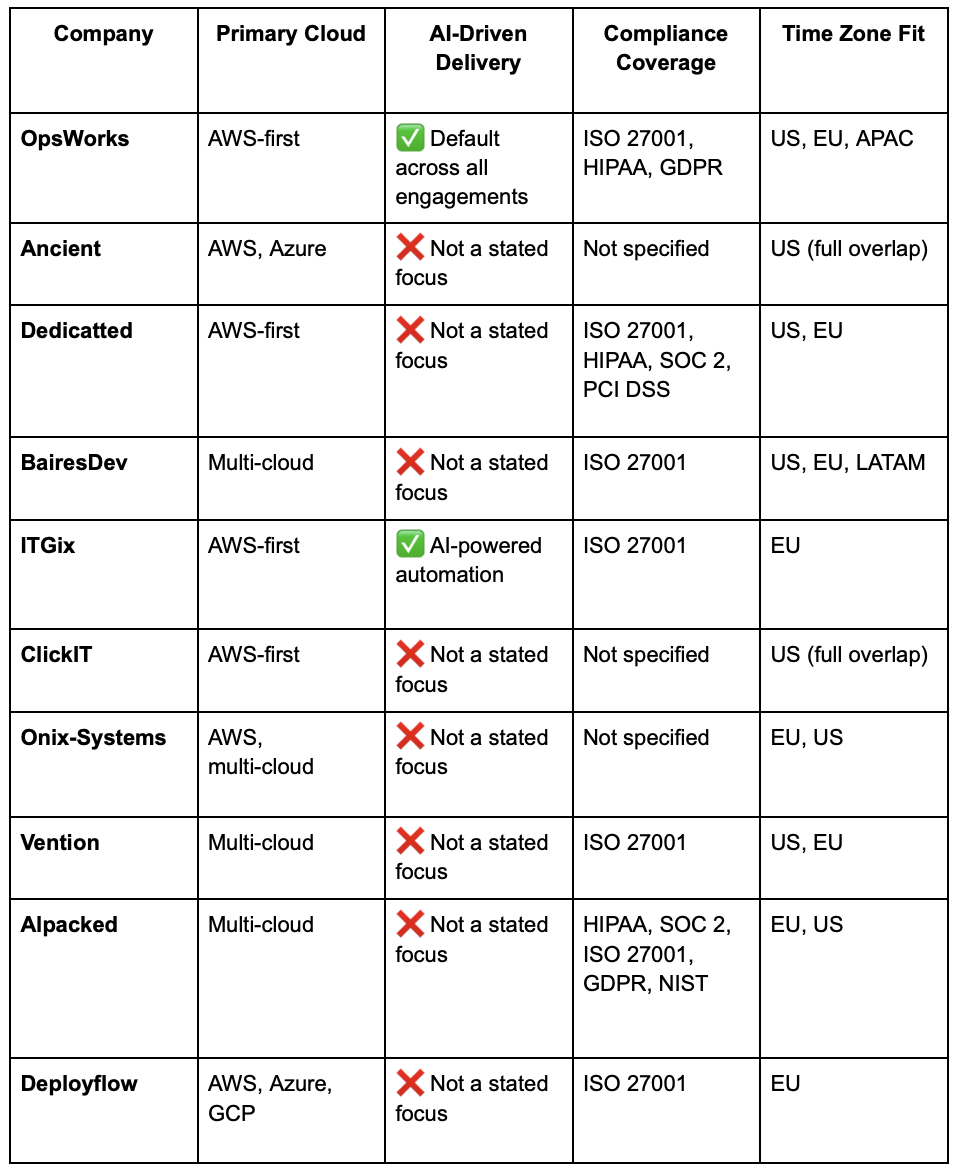
Choosing a DevOps service provider comes down to matching the right capabilities to your specific situation. We have prepared a straightforward framework to guide your decision.
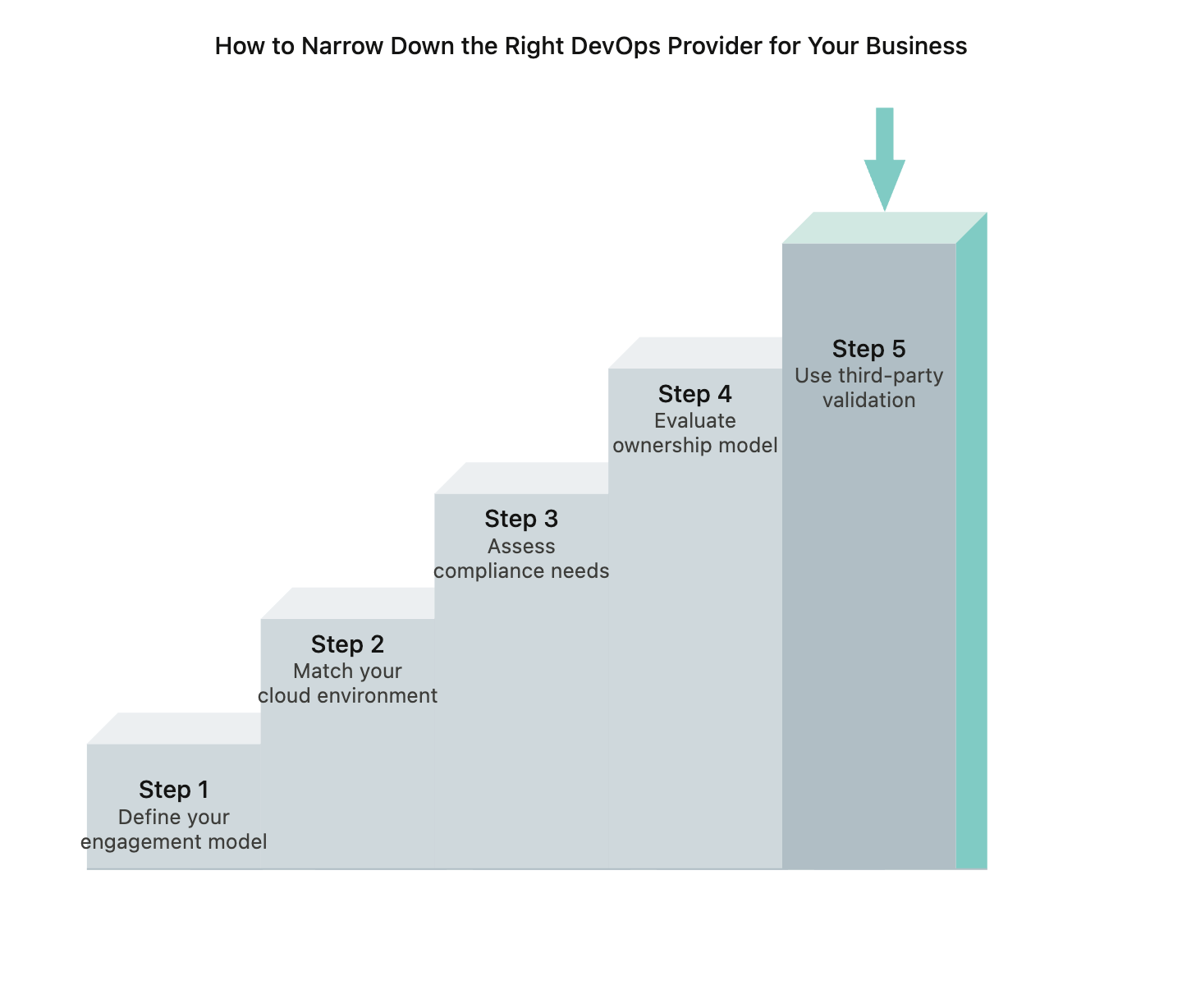
Before evaluating any company, decide what kind of partnership you actually need. Do you want a fully managed DevOps service where the partner takes complete ownership? Do you need staff augmentation to extend an existing internal team?
If your infrastructure runs primarily on AWS, prioritize partners with AWS Advanced Tier or MSP Partner status and a high number of active AWS certifications. If you run a multi-cloud or Azure-first environment, verify that the partner's certifications and case studies reflect that specific experience.
Compliance needs should be a filter. If you operate in highly regulated industries, you need a partner with demonstrated experience delivering advanced solutions for healthcare and fintech, including frameworks like HIPAA, SOC 2, PCI DSS, and ISO 27001. Check whether compliance coverage appears in their case studies and service descriptions.
Look for partners that make post-deployment monitoring, incident ownership, and long-term infrastructure accountability core to their service. If a company's website focuses entirely on onboarding and delivery without mentioning what happens after go-live, that is a gap worth probing.
Check Clutch, G2, and Upwork for verified client reviews. Look at the specifics: do reviewers mention how the team handled difficult situations, for example?
DevOps has proven its benefits: more secure apps, faster iteration, better code quality. The nearshoring model makes those results accessible without the cost and timeline of building an in-house team.
The companies on this list deliver exactly that: certified engineers, time zone alignment, and full infrastructure ownership at a fraction of the cost of local hiring.
The best time to find your DevOps partner is before you need one urgently. Before the second outage of the week. Before the infrastructure bill that nobody can explain.
Start your research now, ask the right questions, and you will find a team that makes your whole engineering operation stronger.
OpsWorks is a strong place to start that research. AWS-certified, AI-driven, and with a track record of measurable results across SaaS, fintech, and healthcare infrastructure.
Look for partners with active compliance certifications relevant to your industry: HIPAA and SOC 2 for healthcare and fintech, PCI DSS for payments, and ISO 27001 for general information security. Verify that compliance appears in their case studies and service descriptions.
Nearshoring works well at both ends of the spectrum. Startups benefit from fast access to senior talent without long hiring cycles or high fixed costs. Enterprises use nearshoring to quickly scale existing DevOps capacity or to fill specialized skills gaps.
It depends on what you already have internally. If you have a DevOps function but need to scale quickly, staff augmentation provides vetted engineers who embed directly into your existing workflows. If you have no internal DevOps practice or want to hand off infrastructure ownership entirely, a fully managed model makes more sense.
Look for three things during your research:
Mature partners build for long-term client independence. Look for companies that document their infrastructure in version-controlled code, maintain clear runbooks, and treat knowledge sharing as a standard part of the engagement. Client reviews that mention well-documented handovers and empowered internal teams are a strong signal that the partner prioritizes your long-term success over contract extension.


Subscribe to our newsletter and get the latest insights that help you stay ahead of the curve.

© 2017-2025 All rights are reserved


