



Your cloud bill grows by 30%. Did your business grow by 30% too?
If the answer is no, the problem is probably not AWS or Azure pricing. It is the gap between what your infrastructure can consume and what your business actually needs.
In 2026, that gap is getting harder to ignore. Flexera's 2026 State of the Cloud Report estimates that 29% of IaaS and PaaS cloud spend is wasted. At enterprise scale, where public cloud bills can reach hundreds of thousands or millions of dollars per month, even a small percentage of inefficient spend becomes a significant business cost. But effective cloud cost optimization is not about making infrastructure as cheap as possible. Cutting resources without understanding workload behavior can simply trade a high cloud bill for poor performance, downtime, or engineering bottlenecks.
The goal is different: Pay for the infrastructure your business actually needs and make every additional dollar of cloud spend support growth, reliability, or performance. This guide explains the cloud cost optimization strategies we consider most relevant for AWS and Azure environments in 2026, from resource rightsizing and commitment discounts to FinOps, automation, and architectural optimization.
Cloud cost optimization is the continuous process of aligning cloud resources, architecture, pricing models, and operational practices with actual business and workload requirements.
It combines several disciplines:
This distinction matters. Cloud cost management tells you where money is going. Cloud cost optimization determines whether that spend is justified and changes the infrastructure when it is not. For enterprise environments, the second part is usually where the larger opportunities exist.
Cloud infrastructure is becoming more complex, not less. According to Flexera's 2026 State of the Cloud Report, 73% of organizations now operate hybrid cloud environments, while multi-cloud adoption continues to increase. At the same time, AI workloads are adding another layer of unpredictable compute, storage, and data-transfer demand. This complexity has financial consequences.
Flexera estimates wasted cloud spend at 29% in 2026, reversing a five-year downward trend. The report also shows that organizations are becoming more disciplined about governance: 71% have a Cloud Center of Excellence or similar function, while FinOps team adoption has reached 63%.
The direction is clear: cloud optimization is moving from an occasional infrastructure cleanup to a continuous operating discipline. For companies running large AWS, Azure, or multi-cloud environments, this means asking more sophisticated questions than "How do we lower this month's bill?"
The better questions are:
That is the foundation of sustainable cloud spend optimization.
Before changing infrastructure, understand what you are paying for.
In mature cloud environments, the problem is rarely the absence of billing data. AWS and Azure provide plenty of it. The challenge is turning thousands of individual charges into meaningful business information.
Start by mapping cloud spend across:
Consistent tagging and labeling are fundamental here. AWS Cost Explorer, AWS Cost and Usage Reports, AWS Budgets, Microsoft Cost Management, and Azure Advisor can help establish this visibility. But dashboards alone do not optimize anything.
The objective should be to move from: "Our AWS bill is $X" to: "Product A costs $X per customer, infrastructure cost increased 14% this quarter, and these three services account for most of that increase"
This is also where FinOps becomes useful. It creates a shared operating model between engineering, finance, and business stakeholders so that cloud decisions are evaluated in terms of both technical requirements and financial impact.
Instead of monitoring only total spend, consider metrics such as:
For Tier 1 companies, these unit economics are considerably more actionable than a monthly cloud invoice.
Overprovisioning is one of the most common sources of unnecessary cloud spend. Teams frequently provision infrastructure for expected peak demand and leave that capacity running continuously. Applications evolve, traffic patterns change, projects end but the original resource allocation remains. Cloud resource rightsizing means matching resource capacity to actual workload requirements.
For AWS, this can include analyzing:
AWS Compute Optimizer can provide recommendations based on historical utilization. In Azure, similar analysis can be performed with Azure Advisor and Azure Monitor across Virtual Machines, managed databases, storage, and other resources.
Enterprise workloads require context. Before downsizing a resource, examine:
A VM running at low average CPU may still be correctly sized if it supports short but business-critical demand spikes. The goal is not maximum utilization. It is the best cost-to-performance ratio for the workload.
Some cloud waste is architectural. Some is much simpler. Development environments stay online overnight. Old snapshots remain indefinitely. Unattached volumes survive after instances are deleted. Test clusters continue running weeks after a project ends. Individually, these resources may appear insignificant. Across dozens of teams and accounts, they accumulate. Look for:
Then automate the lifecycle wherever possible. Non-production infrastructure can often be scheduled to shut down outside working hours. Temporary environments can include expiration policies. Infrastructure as Code can standardize provisioning and decommissioning. This turns a one-time cleanup into an operational control.
Once workloads are properly sized, the next question is how you pay for them.
Running stable workloads entirely on on-demand pricing provides maximum flexibility but often at an unnecessary premium.
For predictable AWS usage, AWS Savings Plans can reduce compute costs in exchange for a one- or three-year usage commitment.
Depending on the workload, companies can combine:
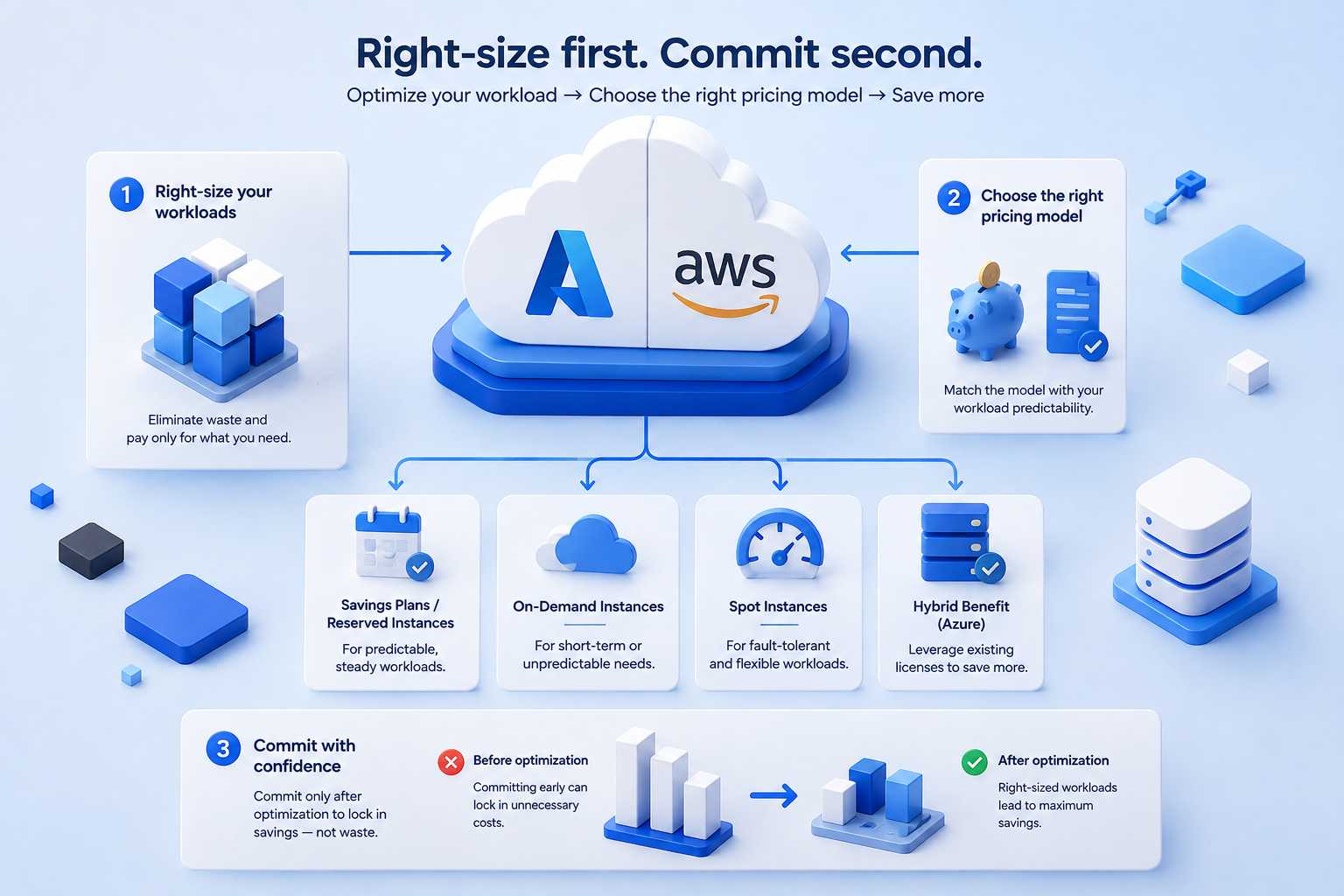
The mistake is purchasing commitments before optimizing the infrastructure. If an organization commits to an oversized environment, it effectively locks its inefficiency into a discounted contract. Right-size first. Commit second.
The same principle applies to Azure Reserved Instances and Azure savings plans for compute. Stable workloads may benefit from reservations, while Azure Hybrid Benefit can create additional savings for eligible organizations already using Windows Server or SQL Server licenses. The optimal mix depends on workload predictability, growth forecasts, architecture, and how much flexibility the organization needs. Commitment discounts should therefore be treated as a capacity planning decision, not simply a purchasing decision.
Autoscaling is usually discussed as a performance feature. It should also be a cost optimization feature. Properly configured infrastructure expands when demand increases and contracts when demand disappears. Poorly configured autoscaling does only the first half.
Review:
For containerized workloads, Kubernetes deserves particular attention. A cluster may appear efficient at the infrastructure level while individual workloads request substantially more CPU or memory than they consume. Correct resource requests, limits, node selection, and autoscaling policies can therefore have a major impact on the final bill. The same principle applies to serverless architectures: consumption-based pricing is efficient only when application behavior, invocation patterns, and downstream services are understood.
Compute is the obvious target for AWS cost optimization and Azure cost optimization, but it is not the only one. At scale, storage and data movement can become significant cost centers.
Review whether data is stored in the appropriate tier based on access frequency and retention requirements. AWS provides options such as S3 Intelligent-Tiering and archival storage classes. Azure offers Hot, Cool, Cold, and Archive access tiers. Lifecycle policies can automatically move data to lower-cost storage or delete it after a defined retention period.
Also review:
Architecture determines how much data moves between services, availability zones, regions, and clouds. For high-volume applications, inefficient data paths can generate substantial recurring charges.
Evaluate whether you can:
This becomes especially important in multi-cloud cost optimization, where architecture decisions can create charges on both sides of a data flow.
At some point, deleting idle resources and buying commitments reaches diminishing returns. The next level of savings comes from architecture. This is also where cloud cost optimization becomes more difficult and more valuable. Consider an application running hundreds of always-on instances because its architecture assumes permanent compute capacity. Rightsizing those instances may save 15-20%. Changing how the workload executes could change the economics entirely.
Possible architectural changes include:
The key question becomes: "Why does this workload cost this much to run in the first place?" That question often reveals opportunities that billing dashboards cannot.
OpsWorks faced exactly this challenge while working with Syndigo, an enterprise content technology company serving thousands of global brands. Its infrastructure spending had reached up to $1 million per month. Instead of simply purchasing cheaper capacity, the team reworked how the workload operated. Processing tasks were redesigned to complete quickly and tolerate interruptions, making it possible to combine dynamic scaling with AWS Spot Instances. The result was infrastructure spending of approximately $80,000 per month a 92% cost optimization. That difference illustrates an important point: The biggest cloud savings may come from changing architecture, not negotiating a better price for the same architecture. See how OpsWorks achieved 92% cost optimization for Syndigo
Cloud cost optimization fails when it is treated as a quarterly finance exercise.
Engineering teams make infrastructure decisions every day. New services are deployed. Capacity changes. Experiments start. Traffic patterns shift.
FinOps brings financial accountability into that operating cycle.
A practical FinOps model connects: Visibility → Accountability → Optimization → Automation. Teams understand what they consume, know what they own, optimize inefficient workloads, and automate controls to prevent the same waste from returning.
For larger organizations, this may include:
The important part is not creating another reporting layer. It is making cost a measurable engineering characteristic, alongside availability, security, performance, and scalability.
AWS and Azure provide different services and pricing models, but the optimization logic is remarkably similar.
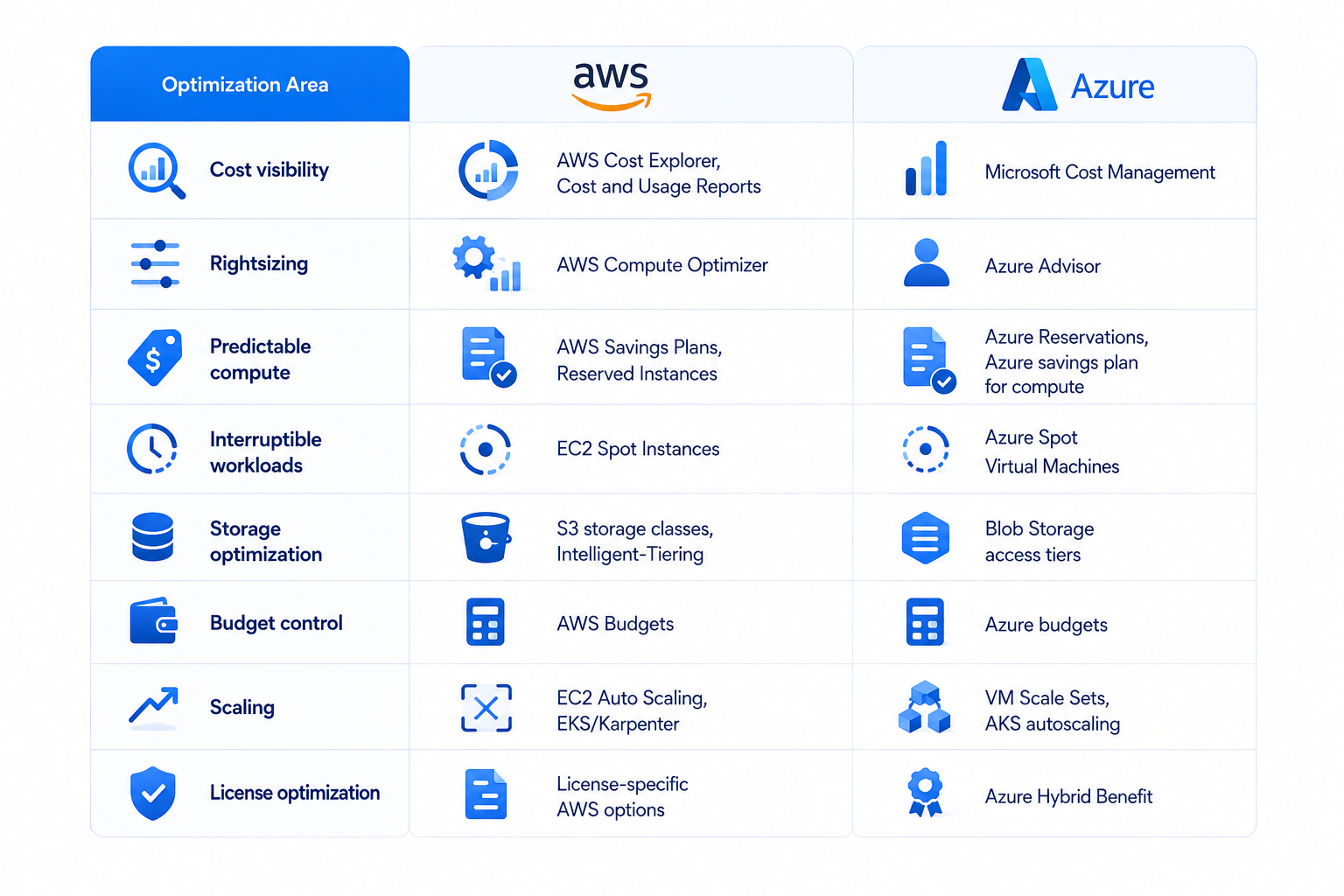
For organizations using both platforms, avoid optimizing AWS and Azure as two isolated environments. Instead, evaluate the entire workload. A cheaper compute service in one cloud does not automatically produce a cheaper architecture if it introduces additional data transfer, duplicated services, operational overhead, or observability complexity.
For a deeper look at the differences between the two cloud platforms, explore our Infrastructure on AWS vs. Azure comparison. If your optimization strategy includes switching cloud providers, see our guide on how to migrate from AWS to Azure.
If your AWS or Azure bill is increasing faster than the value generated by your workloads, start here:
The last point matters most.Cloud environments change every day. A perfectly optimized environment today can accumulate waste again within months.
Optimization is therefore not a project with an end date. It is part of cloud operations.
AWS and Azure already provide strong optimization tools. So why do organizations still struggle with cloud costs? Because tools can tell you that a resource appears underutilized. They cannot always determine why the resource exists, what business process depends on it, or how changing the architecture would affect the application. This is where organizations often reach the limit of tool-only optimization.
If your environment involves:
The optimization problem becomes architectural and operational, not just financial. OpsWorks approaches cost optimization from that perspective. Instead of treating the cloud bill as an isolated finance problem, we analyze how infrastructure is designed, provisioned, scaled, monitored, and operated.
Depending on the environment, that may include:
The objective is straightforward: reduce unnecessary cloud spend without sacrificing the reliability, security, or scalability the business depends on. Cloud cost optimization is often part of a broader DevOps transformation, where infrastructure, automation, scalability, and operational processes are optimized together. Companies can also evaluate whether these capabilities should be built internally or supported by an external provider a decision we explore in DevOps: An In-house Team or Outsource.
The cheapest infrastructure is not necessarily the best infrastructure. A company can reduce its AWS bill by removing redundancy, limiting capacity, and slowing down environments. That is technically cost reduction but it may also increase downtime, weaken resilience, and make engineering teams slower.
Effective cloud cost optimization asks a different question:
What is the most efficient infrastructure that still delivers the performance, reliability, security, and scalability the business requires?
For some organizations, the answer is better rightsizing.
For others, it is AWS Savings Plans or Azure Reserved Instances.
And for complex environments, the largest opportunity may require redesigning how workloads run altogether. That is why cloud optimization in 2026 is increasingly connected to FinOps, platform engineering, automation, and architecture rather than billing alone. If your AWS or Azure costs keep increasing and native recommendations are no longer producing meaningful savings, OpsWorks can assess where the money is going and, more importantly, why your infrastructure needs to spend it in the first place.
Ready to reduce your cloud costs without compromising performance?
Explore our DevOps Transformation services →
Cloud cost optimization is the continuous process of reducing unnecessary cloud expenditure while maintaining the performance, reliability, security, and scalability required by the business. It includes rightsizing, removing idle resources, optimizing pricing models, automating infrastructure, improving architecture, and implementing FinOps practices.
Common AWS cost optimization strategies include EC2 and RDS rightsizing, removing unused resources, using AWS Savings Plans and Reserved Instances for predictable workloads, adopting Spot Instances where interruption is acceptable, optimizing S3 storage, controlling data transfer, improving EKS utilization, and automating scaling.
Azure cost optimization can include VM and database rightsizing, Azure Reservations, Azure savings plans for compute, Azure Hybrid Benefit for eligible licenses, Spot Virtual Machines, storage tiering, automated scaling, and continuous analysis through Microsoft Cost Management and Azure Advisor.
FinOps is an operational framework that brings engineering, finance, and business teams together to maximize the business value of cloud spending. It emphasizes cost visibility, accountability, forecasting, unit economics, optimization, and continuous governance.
Cloud cost management focuses primarily on tracking, allocating, forecasting, and controlling cloud spending. Cloud cost optimization goes further by changing resources, pricing models, operational practices, and architecture to improve the value generated from that spend.
Yes. Multi-cloud cost optimization requires analyzing the combined cost of AWS, Azure, or other providers rather than optimizing each bill independently. This includes workload placement, commitment utilization, duplicated services, data transfer costs, operational overhead, and architecture.


Subscribe to our newsletter and get the latest insights that help you stay ahead of the curve.

© 2017-2025 All rights are reserved


