


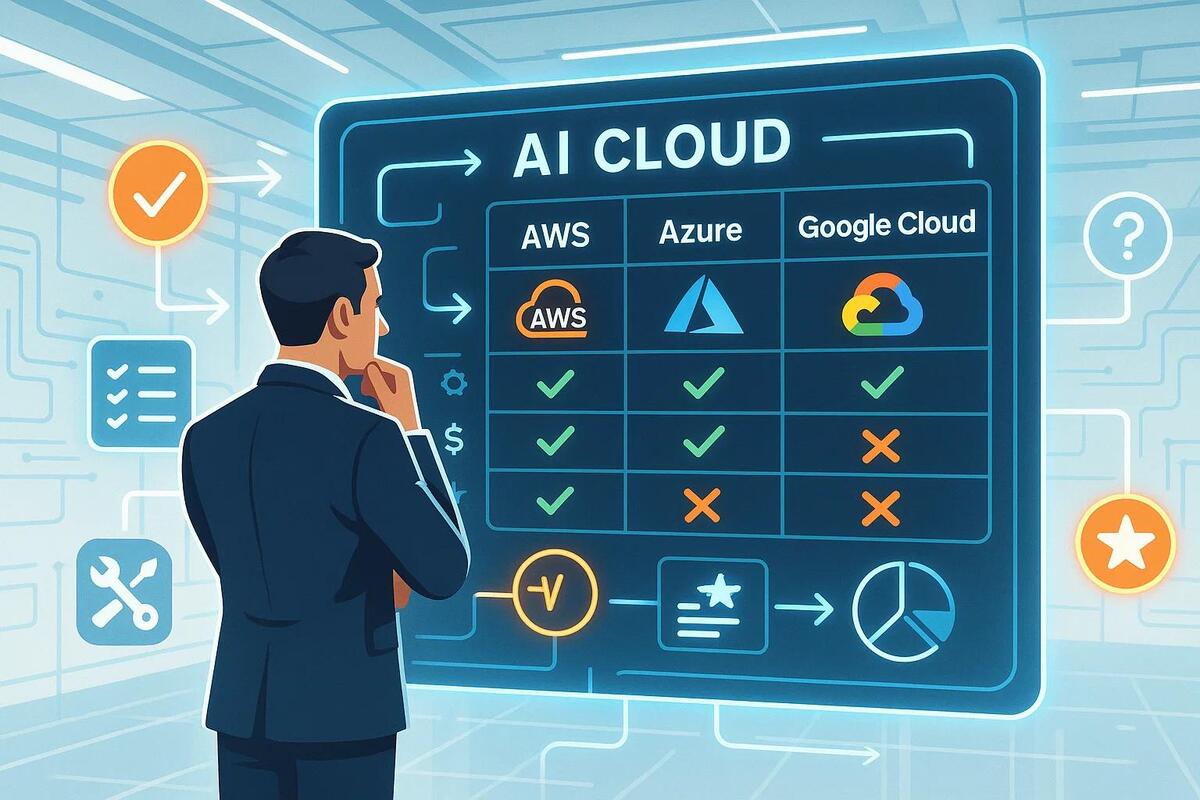

Every major cloud provider now offers a managed AI platform. AWS has Bedrock. Azure has OpenAI Service. Google Cloud has Vertex AI. They all promise easy access to foundation models, enterprise-grade security, and seamless integration with their respective ecosystems. But they are not interchangeable. Each platform makes different trade-offs around model selection, pricing, customization, and ecosystem lock-in. Choosing the wrong one costs you months of rework and unnecessary spend. And in 2026, with AI budgets under more scrutiny than ever, making the right infrastructure decision upfront is the difference between a successful AI deployment and an expensive science experiment. We work with all three platforms daily across dozens of client environments. This is what we have learned about when each one shines — and when it does not.
Before diving into the platforms, it is worth addressing the most common mistake we see: teams pick a platform because of a single model. They want GPT-4, so they go Azure. They want Claude, so they go Bedrock. They want Gemini, so they go Vertex.
This is backwards. Models change every few months. A new release can shift the leaderboard overnight. But your infrastructure — your IAM policies, your data pipelines, your networking, your compliance certifications, your team's muscle memory — those do not change overnight.
The platform you choose determines how you deploy, monitor, secure, and scale your AI workloads for years. The model running on top of it is, in many cases, the easy part to swap. So think about the platform first, and the model second.
Bedrock is AWS's answer to the question: "What if we let you pick any foundation model and run it inside our ecosystem?"
Bedrock offers the broadest model selection of any managed AI platform. You get access to Anthropic's Claude, Meta's Llama, Stability AI, Cohere, Mistral, and Amazon's own Titan models — all through a single API. No need to commit to one model provider. You can test three different models against the same prompt, compare outputs, and switch providers without changing a line of application code.
This model-agnostic approach is genuinely unique. Azure locks you into OpenAI. Vertex AI leans heavily toward Gemini. Bedrock says: bring whatever model you want, we will run it.
Best for teams that want to experiment with multiple models before committing, organizations already deep in the AWS ecosystem (S3, EKS, IAM, CloudFormation), use cases requiring model flexibility, enterprises that need fine-tuning with proprietary data while keeping it in AWS, and regulated industries where data residency within AWS is a hard requirement.
Key strengths include Knowledge Bases for RAG with native S3 integration, Guardrails for content filtering and PII redaction, Agents for multi-step task automation with tool use, fine-tuning and continued pre-training support across multiple model families, pay-per-token pricing with no upfront commitments, and model evaluation tools to compare performance on your specific tasks.
A fintech client of ours runs their customer-facing chatbot on Claude via Bedrock, but uses Llama for internal document summarization where they need full data isolation. Same platform, same security model, two different models optimized for two different jobs. They switch between models with a config change, not a rewrite.
Watch out for costs stacking up across inference, guardrails, knowledge bases, logging, and related AWS services. We have seen teams hit unexpected bills when they enabled logging and knowledge base syncing without understanding the per-request costs. Also, Bedrock's model availability varies by region — not every model is available in every AWS region.
Azure OpenAI is not just "OpenAI with an Azure wrapper." It is the only platform that gives you GPT-4, GPT-4o, and o1 models inside an enterprise-grade environment with full Microsoft 365 integration. That last part is what makes it genuinely different.
If your organization runs on Microsoft — Outlook, Teams, SharePoint, Dynamics, Power Platform — Azure OpenAI plugs into that stack natively. Your AI can search SharePoint documents, process Outlook emails, summarize Teams meetings, and integrate with Power Automate workflows without third-party middleware or custom integrations.
This is not a small advantage. For enterprises where business data lives in Microsoft 365, Azure OpenAI can access and reason over that data with permissions that respect your existing Azure AD policies. No other platform can do this without significant integration work.
Best for enterprises running Microsoft 365 and Azure Active Directory, teams that need the latest OpenAI models with enterprise security and compliance, use cases where AI needs to work with business documents and internal data, organizations in regulated industries that need Azure's compliance certifications, and companies already invested in the Microsoft Copilot ecosystem.
Key strengths include exclusive access to the full OpenAI model family with early access to new releases, native integration with Microsoft Copilot and Microsoft Graph, Provisioned Throughput Units (PTU) for predictable performance at scale, content filtering and responsible AI tools, Azure AI Search for enterprise RAG with hybrid and vector search, the On Your Data feature that grounds GPT responses in your own documents, and private endpoints with VNet integration for full network isolation.
A healthcare client uses Azure OpenAI with On Your Data to let clinicians ask questions about internal treatment protocols stored in SharePoint. The system respects document-level permissions through Azure AD — a doctor in cardiology sees different results than a nurse in pediatrics, all without custom authorization code.
Watch out for limited model selection. If you need Claude, Llama, or Gemini, you are looking at going multi-cloud. Also, Azure OpenAI has a quota system that can be frustrating for teams ramping up quickly. Plan your capacity needs ahead of deployment.
Vertex AI reflects Google's core strength: data infrastructure. If BigQuery is your data warehouse and your analytics teams already think in GCP, Vertex AI speaks your language before you write a single line of code.
Two things set Vertex AI apart. First, Google's Gemini models offer genuinely strong multimodal capabilities — text, image, video, and code — in ways that are ahead of the competition. Second, the integration between Vertex AI and BigQuery is tighter than anything AWS or Azure offers with their respective data warehouses. You can run ML directly on your BigQuery tables without moving data.
Best for organizations with data infrastructure on GCP (BigQuery, Cloud Storage, Dataflow), teams building multimodal AI applications, use cases requiring direct AI-to-data-warehouse integration, data science teams that need end-to-end MLOps, and organizations that need strong multimodal search capabilities.
Key strengths include Gemini models with industry-leading multimodal capabilities including video understanding, Model Garden with 150+ models, direct BigQuery ML integration with SQL-based inference, Vertex AI Pipelines for end-to-end MLOps, competitive pricing especially for Gemini Flash models, Grounding with Google Search to reduce hallucination, and context caching for cost reduction.
A media company uses Vertex AI to process and tag thousands of hours of video content automatically. Gemini's native video understanding means they can ask questions about video content without extracting frames. The tagged metadata flows directly into BigQuery alongside viewership data.
Watch out for GCP's smaller enterprise market share, which means fewer third-party integrations and a smaller talent pool. While Model Garden offers many models, the non-Google models sometimes lag behind versions available elsewhere.
Pricing for managed AI platforms is notoriously hard to compare. Here is what you actually pay for beyond per-token inference costs.
AWS Bedrock: Per-token inference is your primary cost. But add Knowledge Bases (per query and per sync), Guardrails (per assessment), model customization jobs (per training hour), and CloudWatch logging. A typical RAG application with guardrails costs 30-50% more than raw inference alone.
Azure OpenAI: Standard deployments use pay-per-token pricing. For production workloads, most enterprises move to Provisioned Throughput Units (PTU), which are monthly commitments that guarantee capacity. Azure AI Search for RAG adds its own pricing tier.
GCP Vertex AI: Per-token pricing is competitive, especially for Gemini Flash which can be 10-20x cheaper than GPT-4 class models. Context caching reduces costs further. BigQuery ML inference is billed through BigQuery's standard pricing.
The cheapest option depends on your usage pattern. High-volume predictable workloads favor Azure PTUs. Bursty experimental workloads favor Bedrock's pay-per-token model. Cost-sensitive applications favor Vertex AI with Gemini Flash.
Stop thinking about which platform is "best." Start thinking about which one reduces friction for your specific situation.
Choose AWS Bedrock when your infrastructure is on AWS, your team knows IAM and CloudFormation, and you want the freedom to test multiple models without vendor lock-in. Bedrock is also right when you are not sure which model will work best — its model-agnostic API means you can experiment and switch later without rearchitecting.
Choose Azure OpenAI when your organization lives in the Microsoft ecosystem, your data is in SharePoint and Dynamics, and you need the latest OpenAI models with enterprise compliance. Azure OpenAI is also right when your primary use case is internal productivity — copilots, document Q&A, email summarization — because the Microsoft 365 integration is unmatched.
Choose GCP Vertex AI when your analytics stack runs on BigQuery, you need strong multimodal capabilities especially video, and you want tight data warehouse integration. Vertex AI is also right when cost efficiency is a primary concern and Gemini Flash meets your quality requirements.
Go multi-cloud when you have workloads that genuinely benefit from different platforms — for example, using Azure OpenAI for internal copilots while running Bedrock for customer-facing AI with model flexibility. This is where an experienced cloud partner pays for itself.
After helping dozens of organizations deploy AI across these platforms, here are the patterns that consistently lead to problems.
Picking the platform based on a demo. A slick demo using GPT-4 on Azure does not mean Azure is right for your production workload. Demos do not show you the quota limits, the networking complexity, or the billing surprises at scale.
Ignoring data gravity. If 80% of your data is in S3, building your AI pipeline on Vertex AI means you are paying for cross-cloud data transfer on every inference call. Build your AI where your data already lives.
Over-engineering for multi-cloud from day one. Multi-cloud AI makes sense when you have distinct workloads that benefit from different platforms. It does not make sense as a strategy before you have a single working AI application. Start with one platform, prove the value, then expand.
Treating the platform choice as permanent. The abstraction layers are getting better every month. If you build with clean interfaces between your application logic and your AI provider, switching platforms later is a manageable engineering project, not a rewrite.
None of these platforms is objectively the best. Each is the best for a specific kind of organization, with a specific existing stack, and a specific set of priorities.
The worst decision is picking a platform because of a single model's benchmark scores, then spending six months fighting your own infrastructure to make it work. The right decision starts with understanding where your data lives, what your team knows, and what problem you are actually solving.
The second-worst decision is analysis paralysis — spending months evaluating platforms instead of building. In most cases, if you are already on AWS, start with Bedrock. If you are on Azure, start with Azure OpenAI. If you are on GCP, start with Vertex AI. You can always add a second platform later when you have a concrete reason.
At OpsWorks, we build and operate AI infrastructure across all three clouds. Whether you are evaluating platforms, migrating workloads, or scaling an existing AI deployment — we help you make the choice that fits your business, not just the hype cycle.
Ready to figure out which platform fits your AI workload? Book a call with our team.


Subscribe to our newsletter and get the latest insights that help you stay ahead of the curve.

© 2017-2025 All rights are reserved


