



Developers should not need to understand every Kubernetes manifest, Terraform module, IAM policy, deployment pipeline, and observability tool just to ship a service. Yet as cloud-native environments scale, that is often what happens. The result is predictable: more DevOps tickets, duplicated CI/CD pipelines, inconsistent infrastructure, longer onboarding, security exceptions, and developers spending more time navigating infrastructure than building products. An internal developer platform (IDP) addresses this problem by turning infrastructure and delivery capabilities into standardized, self-service developer workflows. But an IDP is not simply a developer portal on top of Kubernetes. Its value comes from the architecture, automation, guardrails, and operating model behind it. This guide explains internal developer platform architecture, its core components, when an IDP makes sense, and how to implement one without creating another layer of engineering complexity.
An internal developer platform is a self-service layer that gives developers standardized ways to provision infrastructure, deploy applications, access observability, and perform common operational tasks.
A practical IDP typically combines:
An IDP is best suited to organizations with multiple engineering teams, growing cloud-native infrastructure, repeated DevOps requests, inconsistent delivery workflows, or strong governance requirements. The biggest implementation mistake is starting with a platform tool before identifying the developer workflows that actually create friction.
An internal developer platform is a collection of integrated tools, automation, services, and workflows that enables developers to build, deploy, and operate applications through self-service capabilities. The platform team manages the underlying complexity. Application teams consume standardized capabilities.
For example, instead of asking a DevOps engineer to provision infrastructure for a new service, a developer could select an approved template and trigger an automated workflow that creates:
The underlying technologies do not disappear. They become standardized and automated. This reduces cognitive load while giving developers enough visibility to understand and troubleshoot their applications. Google Cloud similarly describes internal developer platforms as a way to provide secure, standardized developer experiences through automation, templates, and golden paths.
These concepts are related, but they are not the same.
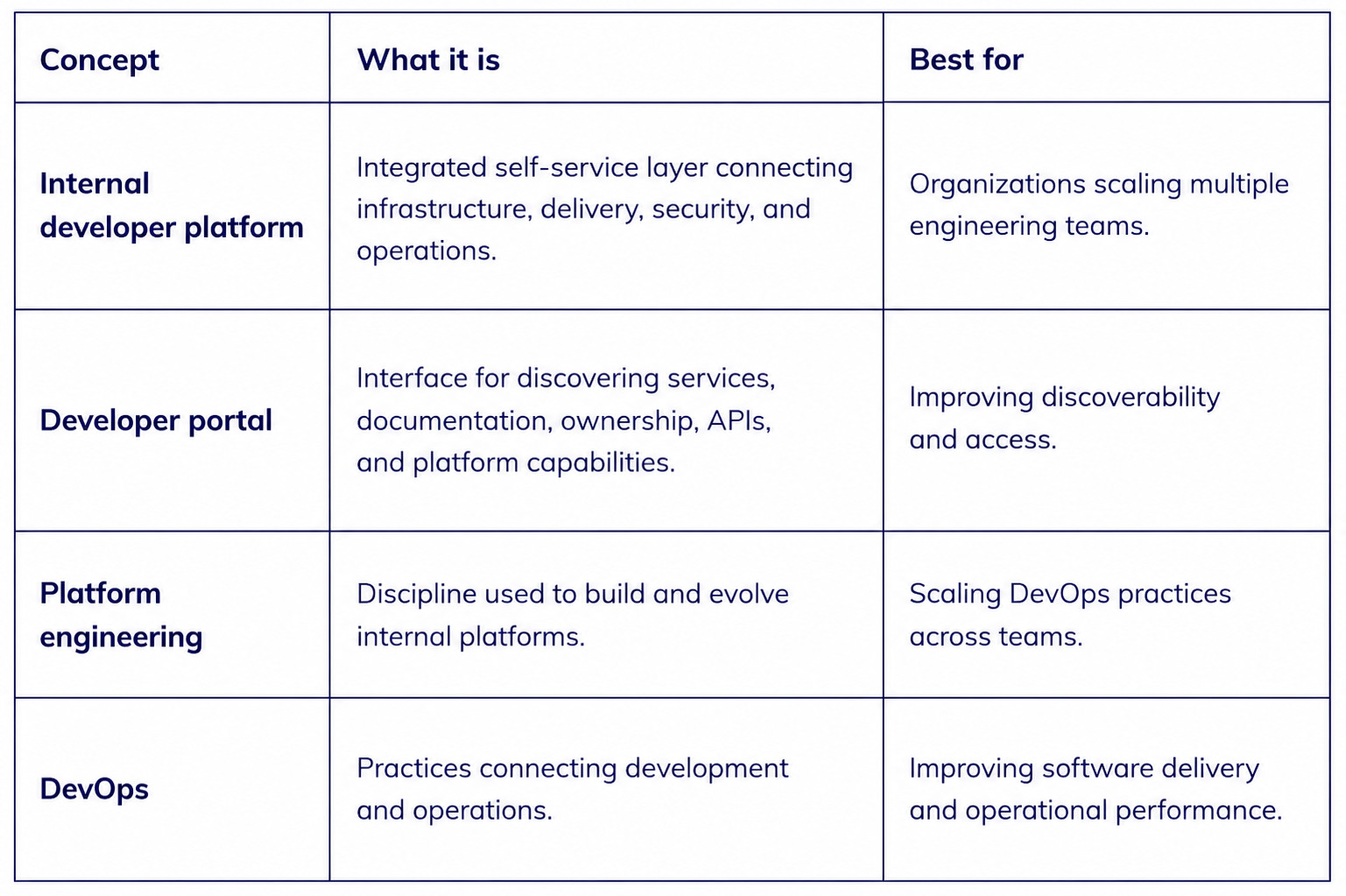
A developer portal can be part of an internal developer platform, but the portal alone is not the platform. Likewise, platform engineering is the discipline; an IDP is one of the products a platform team may build. For a deeper comparison, see OpsWorks' guide to DevOps vs. Platform Engineering.
Not every organization needs an IDP. For a small engineering team with straightforward infrastructure, introducing a dedicated platform may create more complexity than it removes.
An IDP becomes more valuable when:
These are signs that infrastructure knowledge and operational decisions are being repeatedly recreated across the organization. OpsWorks' DevOps Maturity Model describes self-service capabilities and platform engineering as characteristics of more optimized DevOps environments.
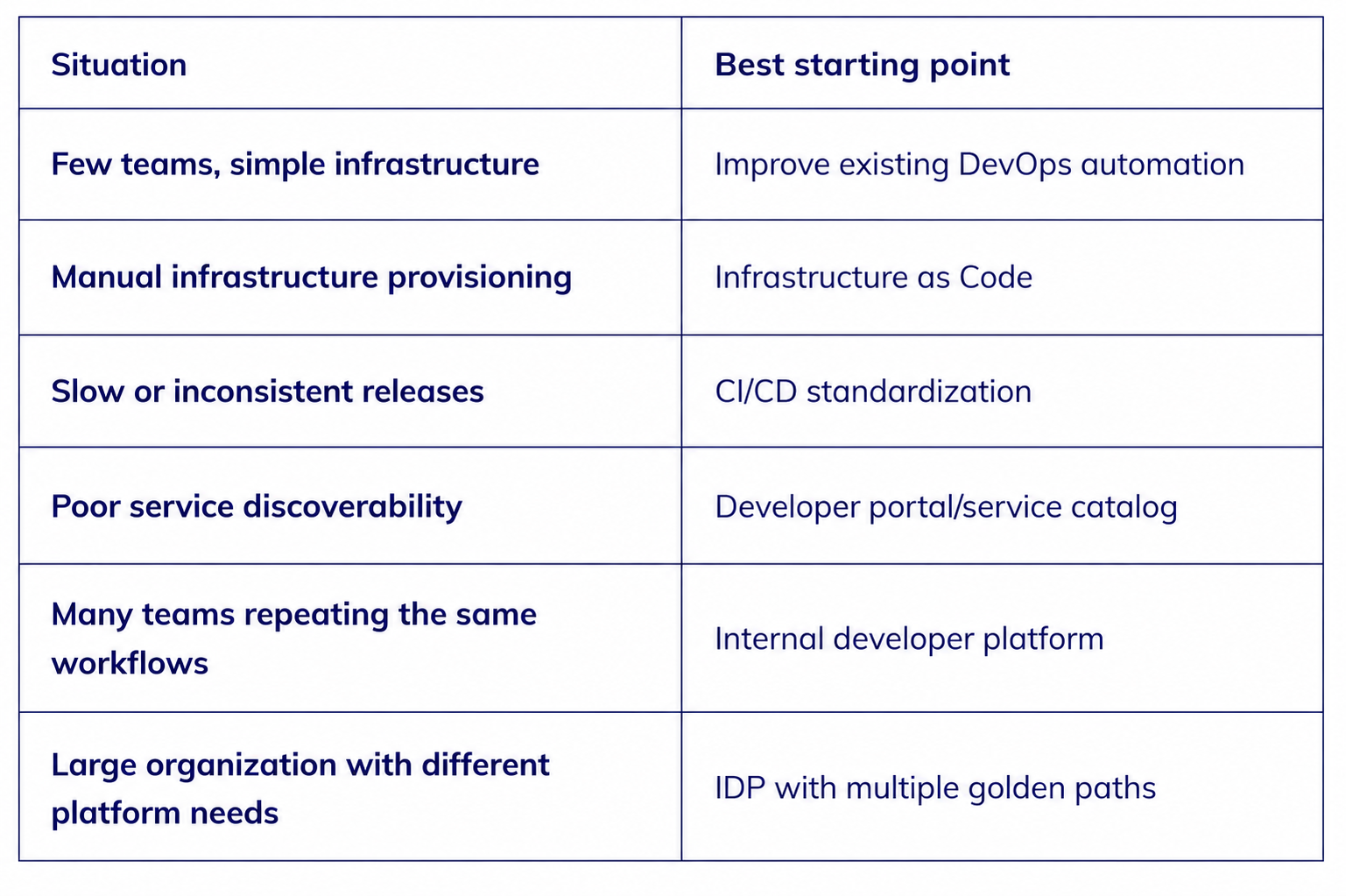
The principle is simple: build a platform when you have repeated problems worth turning into reusable capabilities.
A good internal developer platform architecture separates the developer experience from unnecessary infrastructure complexity.
A typical architecture connects several layers:
The platform connects these layers so developers can use infrastructure through standardized workflows without managing every underlying tool directly. The IDP should not replace every tool already in use. It should orchestrate them into consistent developer workflows.
The exact technology stack will differ between organizations, but most successful platforms combine a small set of core capabilities.
The developer portal acts as the front door to platform capabilities.
It can provide access to:
The service catalog provides a structured system of record for these resources. But discoverability alone is not enough. The portal becomes more valuable when developers can perform actions through it, such as creating a service or provisioning an environment.
Golden paths are standardized, supported workflows for common engineering tasks.
Examples include:
Instead of every team assembling its own Terraform, CI/CD, Kubernetes, monitoring, and security configuration, the platform provides a tested path. The goal is not to eliminate flexibility. It is to make the recommended approach the easiest one.
Developer self-service allows engineers to request approved infrastructure without waiting for manual intervention.
Typical capabilities include:
Infrastructure as Code provides the automation behind these workflows. A developer might request a “production PostgreSQL database,” while the platform translates that request into an approved IaC module with networking, encryption, backups, monitoring, and access policies. This creates a balance between developer autonomy and infrastructure governance. Infrastructure as Code implementation is also part of OpsWorks DevOps Transformation services.
An IDP should integrate with existing developer workflows rather than create a separate delivery system.
The platform can standardize:
This reduces duplication between teams and makes future improvements easier to implement across the organization.
Kubernetes is common in internal developer platforms, but it is not mandatory.
An IDP may orchestrate:
The architecture should follow workload requirements rather than forcing every application onto the same technology.
Self-service should not stop when an application reaches production.
Production-ready workflows should automatically include appropriate:
Security and observability should not be added after deployment. A well-designed IDP embeds operational and security controls into approved developer workflows by default. For enterprise organizations, this is one of the strongest arguments for adopting an IDP.
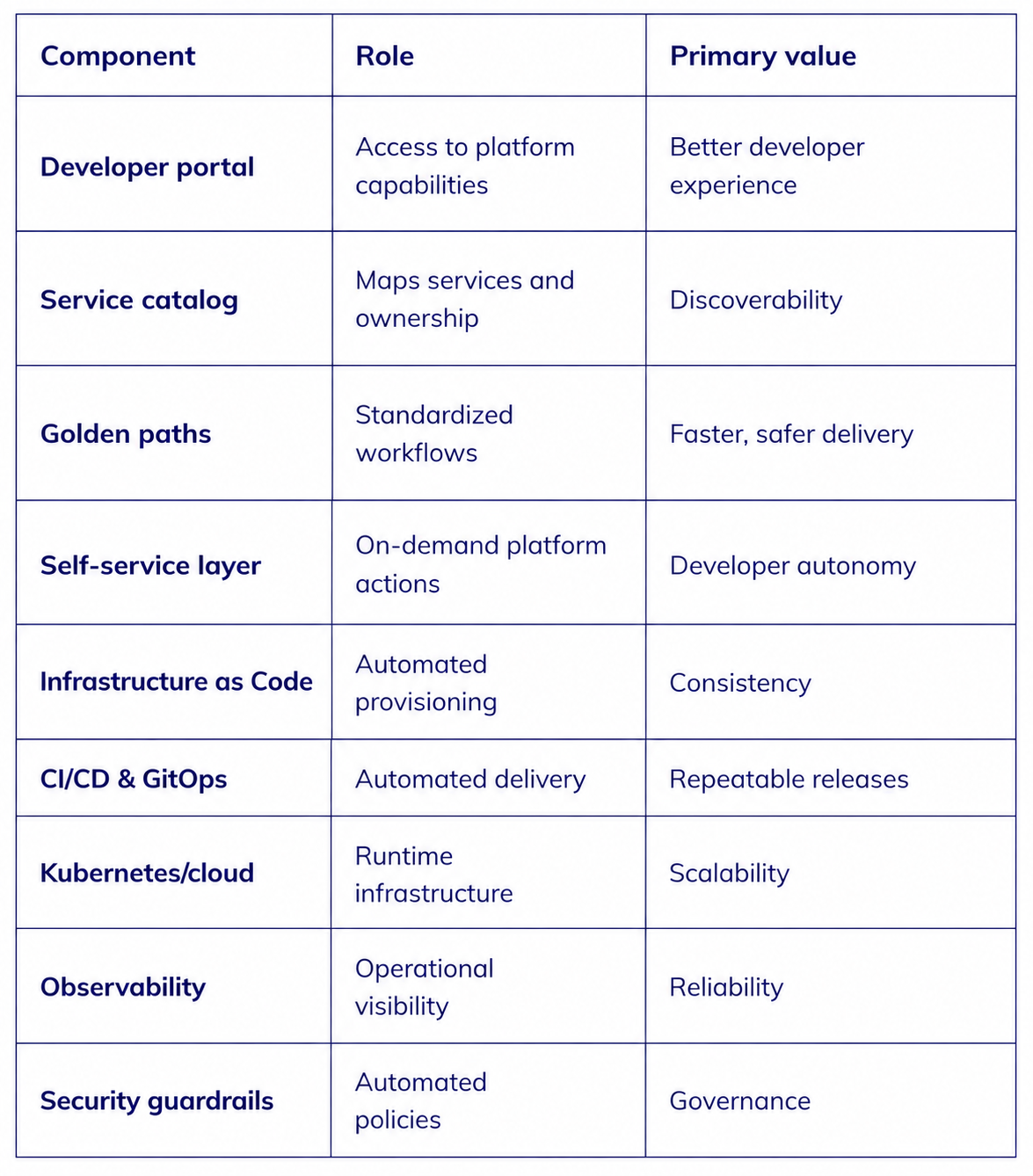
The best platform is not the one with the most components. It is the smallest set of capabilities that removes meaningful friction from developer workflows.
Organizations generally have three options: build internally, adopt a commercial platform, or combine both.
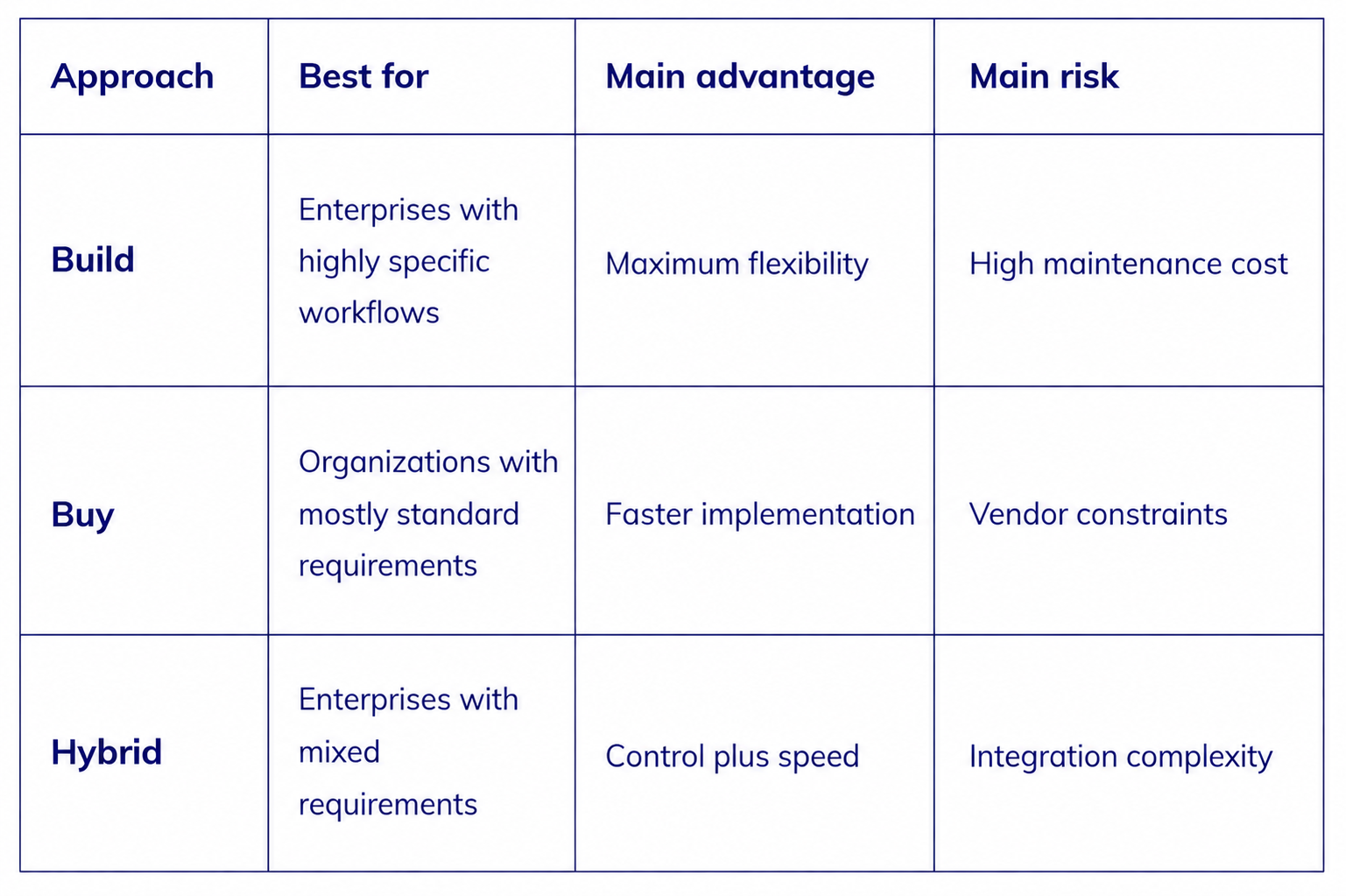
Your workflows, security requirements, or infrastructure model are sufficiently unique to justify ongoing platform engineering investment.
Existing products already solve most requirements and time to value matters more than customization.
You want to retain control over infrastructure automation and governance while using established products for areas such as the developer portal or service catalog.
The better question is therefore not:
“Which IDP should we buy?”
It is:
“Which capabilities are unique enough to build, and which should we integrate?”
The biggest internal developer platform implementation mistake is starting with technology. Deploying a developer portal or Kubernetes platform does not automatically create useful self-service. Start with developer friction.
Map how developers currently:
Look for repeated handoffs, tickets, delays, and duplicated work. For example, a developer may need a database but first has to submit a DevOps ticket, wait for an Infrastructure as Code update and security review, and only then receive access. If this process occurs regularly, it is a strong candidate for developer self-service. This assessment is closely related to the capability analysis described in the OpsWorks DevOps Maturity Model.
Do not try to platformize everything at once. Prioritize workflows based on how often they occur, how much developer and platform team time they consume, and how strongly they affect business outcomes.
Good first candidates usually include:
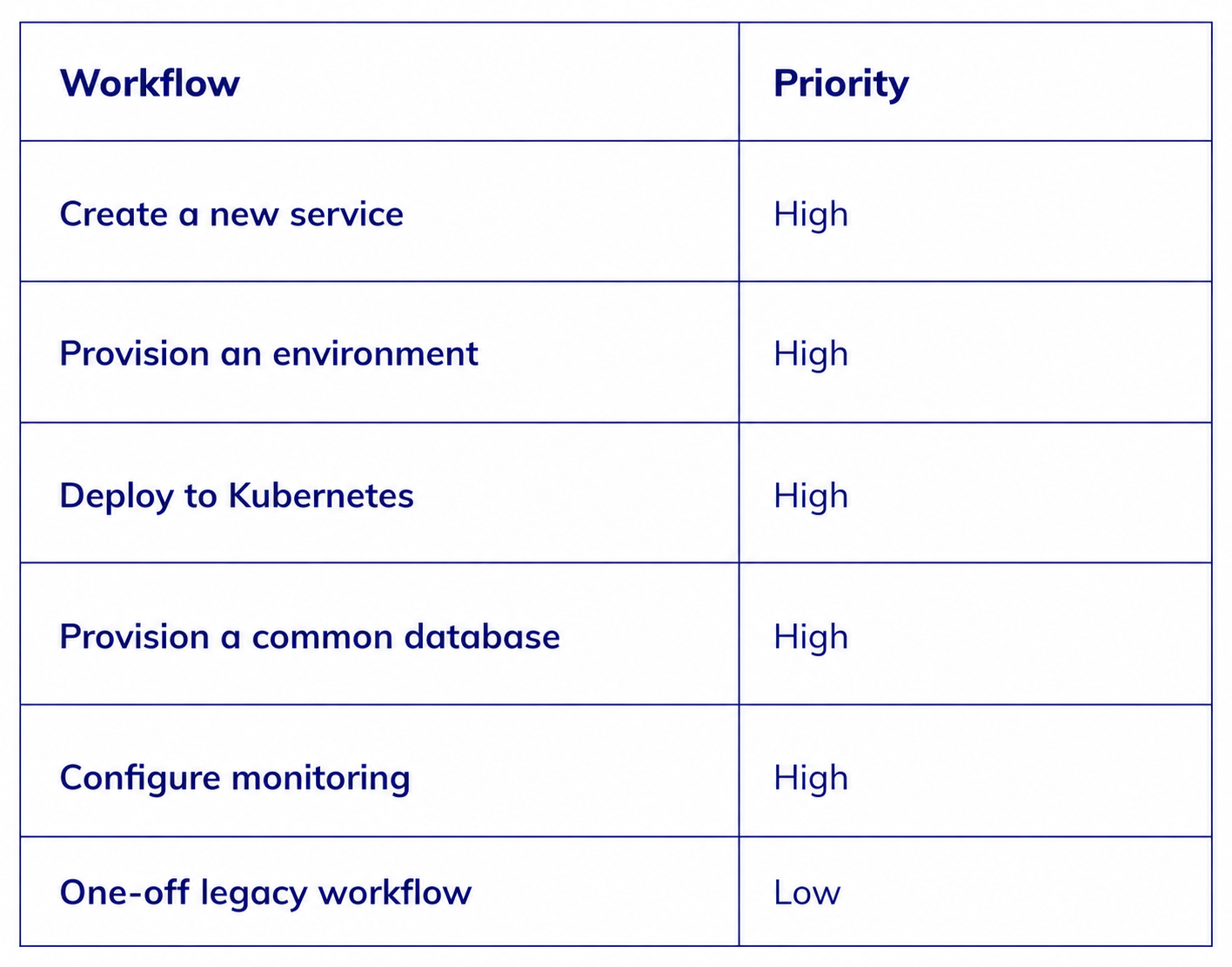
This keeps the first version focused on measurable value.
Before exposing infrastructure through self-service, standardize the underlying:
If five teams deploy the same application in five different ways, adding a portal will not solve the underlying inconsistency. The right sequence is to standardize the process first, automate it, and then make it available through self-service.
Start with one or two complete golden paths.
For example, a “Create New Service” workflow could:
One useful end-to-end workflow is more valuable than dozens of integrations developers rarely use.
Encode governance directly into the platform through:
Then treat the platform as a product. Measure usage, collect developer feedback, improve golden paths, and remove unnecessary friction. Developers are the platform's customers. If they consistently bypass it, the platform needs improvement.
Platform adoption alone is not enough.
The IDP should improve developer experience and operational performance.
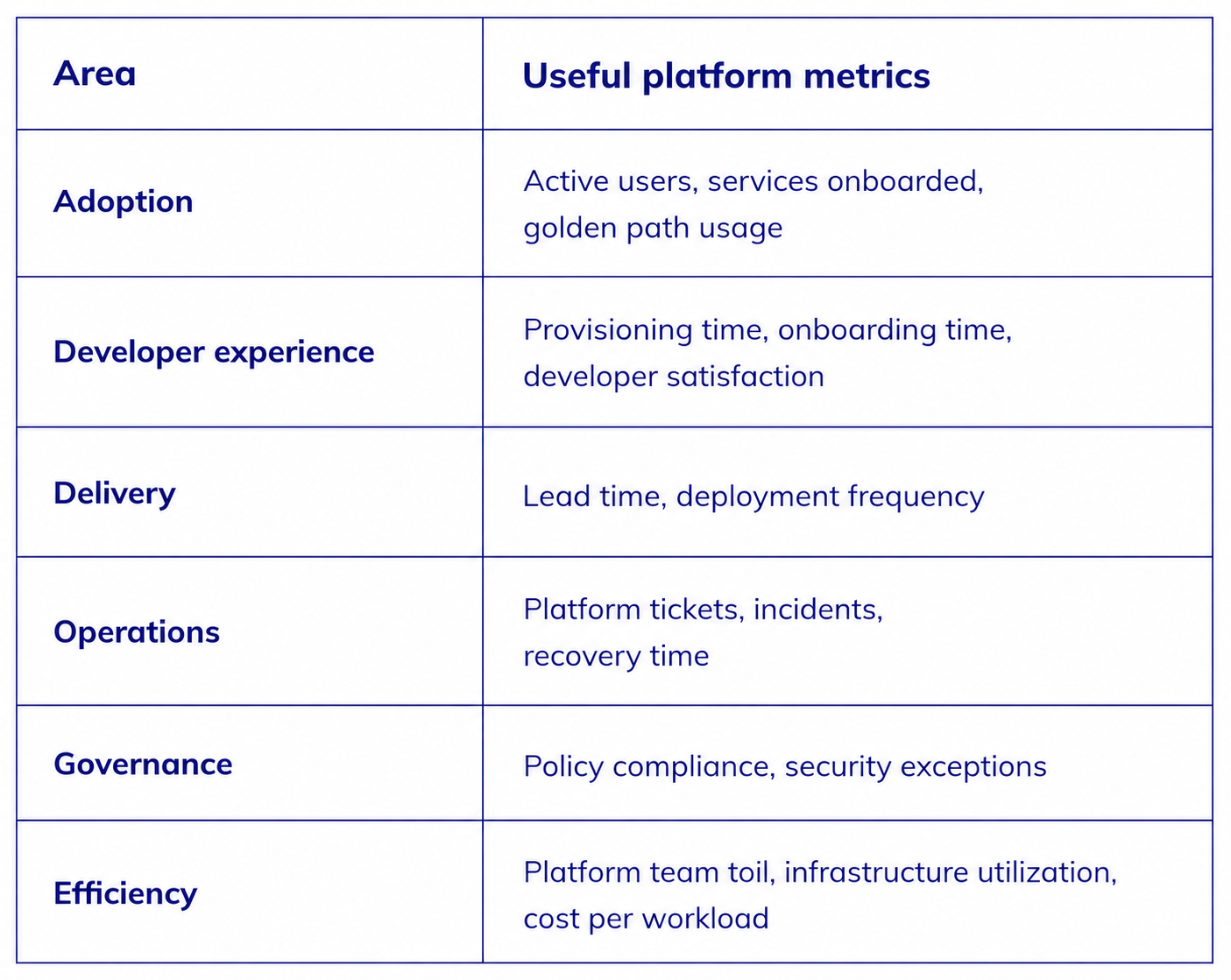
Two particularly useful indicators are: Time to first production deployment, how quickly a new engineer or service can reach production. Ticket deflection, how many routine infrastructure requests developers can now complete independently. These metrics connect platform engineering to business value more clearly than counting integrations or platform features.
A polished interface does not create self-service if every action still ends with a DevOps ticket.
Start with common workflows that can be standardized. Edge cases can remain outside the platform.
Reduce unnecessary cognitive load, but keep enough infrastructure context for developers to troubleshoot their applications.
A good golden path should be easier than building the same capability independently.
“20 platform integrations” is not a meaningful result. “Environment provisioning dropped from two days to 15 minutes” is.
An internal developer platform often becomes relevant when an organization has already automated infrastructure but that automation is difficult for development teams to consume. Terraform exists. CI/CD exists. Kubernetes exists. Observability exists. But developers still need to understand how every system fits together. Platform engineering turns these capabilities into reusable services that teams can consume independently. A typical progression starts with manual operations, followed by DevOps automation and standardized workflows. Once these foundations are reliable, organizations can introduce developer self-service and gradually move toward platform optimization. This is why an IDP should rarely be the first step in a DevOps transformation. If infrastructure provisioning, CI/CD, Kubernetes, observability, or security controls are inconsistent, those foundations should be addressed first. OpsWorks' DevOps Transformation services cover the capabilities required for this transition, including DevOps assessment, CI/CD implementation, Infrastructure as Code, monitoring, scalability analysis, performance optimization, autoscaling, and containerization. Cost visibility should also be considered as the platform grows. The OpsWorks guide to cloud cost optimization explains how infrastructure decisions can be connected to workload efficiency and cloud spend.
The best internal developer platform is not the one with the most integrations. It is the one developers actually choose to use. A useful platform turns repeated infrastructure decisions into reliable capabilities. It provides autonomy where autonomy creates speed and guardrails where the organization needs control.
Start with one question:
Where are developers waiting on infrastructure instead of building software?
Find the repeated workflow behind that friction. Standardize it. Automate it. Make it self-service. Then measure whether delivery actually improved. For organizations where fragmented infrastructure and delivery workflows are already limiting engineering scale, OpsWorks can assess the existing environment and determine which capabilities should be standardized, automated, or exposed through an internal developer platform. Explore OpsWorks DevOps Transformation
An internal developer platform is a self-service layer that integrates infrastructure, deployment, security, observability, and developer tooling into standardized workflows. It allows developers to perform common operational tasks without depending on DevOps engineers for every request.
Common components include a developer portal, service catalog, golden paths, self-service infrastructure, Infrastructure as Code, CI/CD or GitOps, Kubernetes or cloud infrastructure, observability, and security guardrails.
Internal developer platform architecture typically connects a developer interface with service catalogs and golden paths, platform orchestration, CI/CD and Infrastructure as Code, runtime infrastructure, observability, and security capabilities.
A developer portal provides an interface for discovering and accessing engineering resources. An internal developer platform includes the automation, infrastructure, workflows, and governance needed to perform actions through self-service.
Start by identifying repeated developer friction, standardize the underlying infrastructure and delivery patterns, automate high-value workflows, expose them through self-service, add security guardrails, and measure adoption and developer outcomes.
No. An IDP can orchestrate Kubernetes, virtual machines, serverless services, managed cloud services, or hybrid infrastructure depending on workload requirements.
Build when requirements are highly specific and justify long-term platform engineering investment. Buy when standard capabilities cover most requirements and faster implementation is the priority. Large enterprises often use a hybrid approach.


Subscribe to our newsletter and get the latest insights that help you stay ahead of the curve.

© 2017-2025 All rights are reserved


