


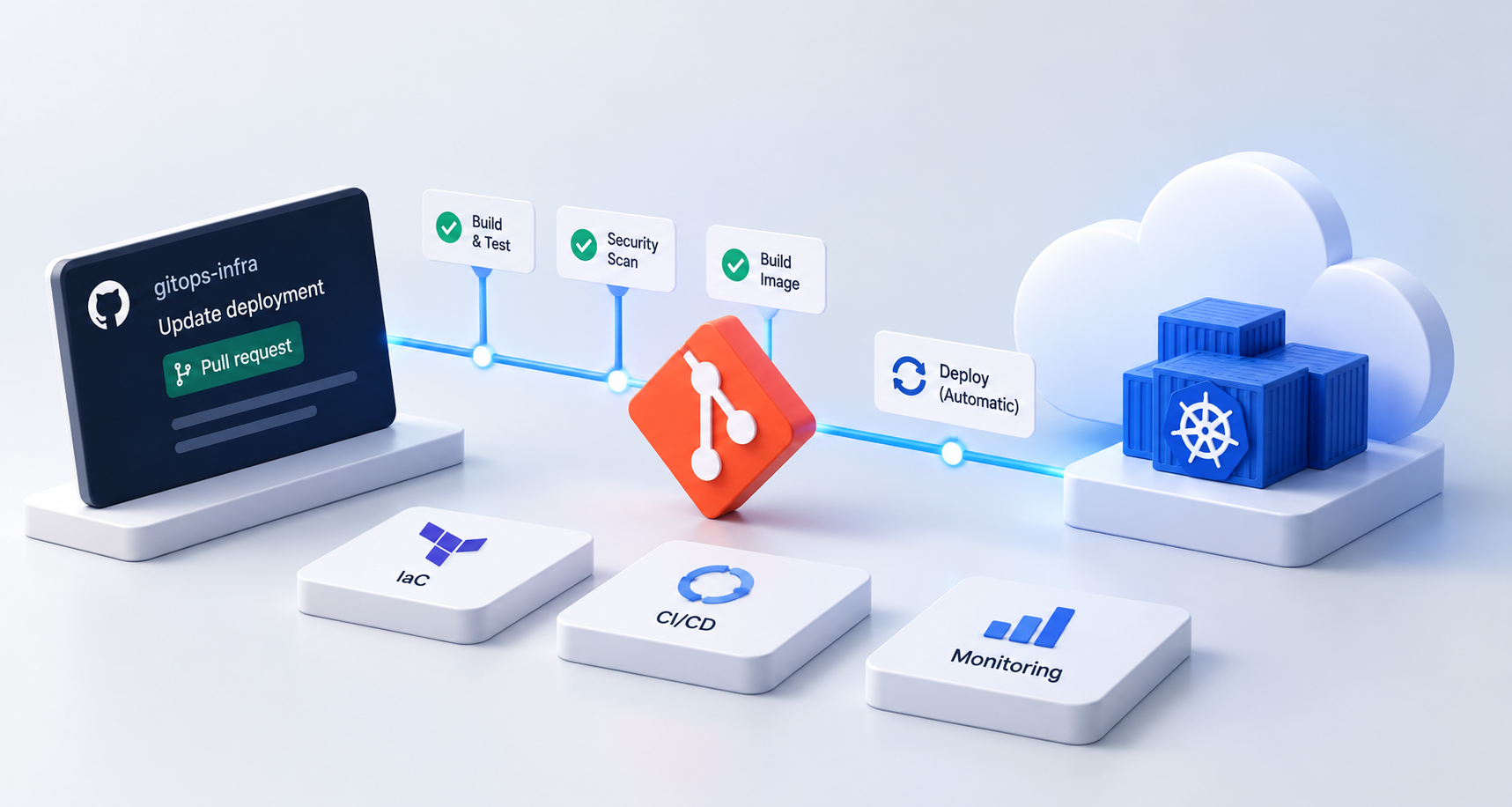

A deployment pipeline can be fully automated and still leave production infrastructure out of control. A failed script updates one environment but not another. A Kubernetes configuration is fixed manually and never committed. A CI pipeline holds more production access than it needs. Across dozens of services, clusters, and engineering teams, these exceptions become an operating model problem. GitOps addresses that problem by making infrastructure changes declarative, version-controlled, reviewable, and continuously reconciled. Instead of using automation only to push changes into production, GitOps defines the approved state in Git and keeps running environments aligned with it. This guide explains what GitOps is, how its architecture and workflow operate, how it works with Kubernetes, CI/CD, and Infrastructure as Code, which GitOps tools to consider, and how to implement GitOps automation across cloud infrastructure at scale.
GitOps is an operating model that uses Git as the source of truth for the desired state of applications and infrastructure. Changes are reviewed and versioned in Git, while automated controllers continuously reconcile live environments with the approved configuration.
For enterprise teams, GitOps can provide:
GitOps is most valuable when an organization already has mature Infrastructure as Code and CI/CD practices but struggles to manage deployments consistently at scale. If infrastructure is still largely manual, standardizing IaC and CI/CD should usually come first.
GitOps applies software development practices such as version control, pull requests, automated validation, and continuous reconciliation to infrastructure operations. The central principle is simple: Git stores the approved desired state, while automation keeps the running environment aligned with it. For example, if a Kubernetes deployment should run five replicas of a specific container version, that configuration is stored in Git. A GitOps controller continuously compares it with the cluster. If someone manually changes the live environment or configuration drifts, the controller detects the difference and can restore the approved state. This makes Git more than a place to store configuration. It becomes part of the operational control model.
As cloud environments grow, deployment logic often becomes fragmented across pipelines, clusters, environments, and teams. GitOps introduces a consistent model for controlling these changes and makes infrastructure easier to reproduce, audit, and recover.
The business impact appears in four areas:
GitOps therefore fits naturally into mature DevOps environments. As discussed in the OpsWorks DevOps Maturity Model, reproducible infrastructure, automation, security controls, and standardized workflows become increasingly important as organizations scale.
A production GitOps architecture is more than a Git repository connected to Kubernetes. It usually contains several distinct layers with clearly separated responsibilities.
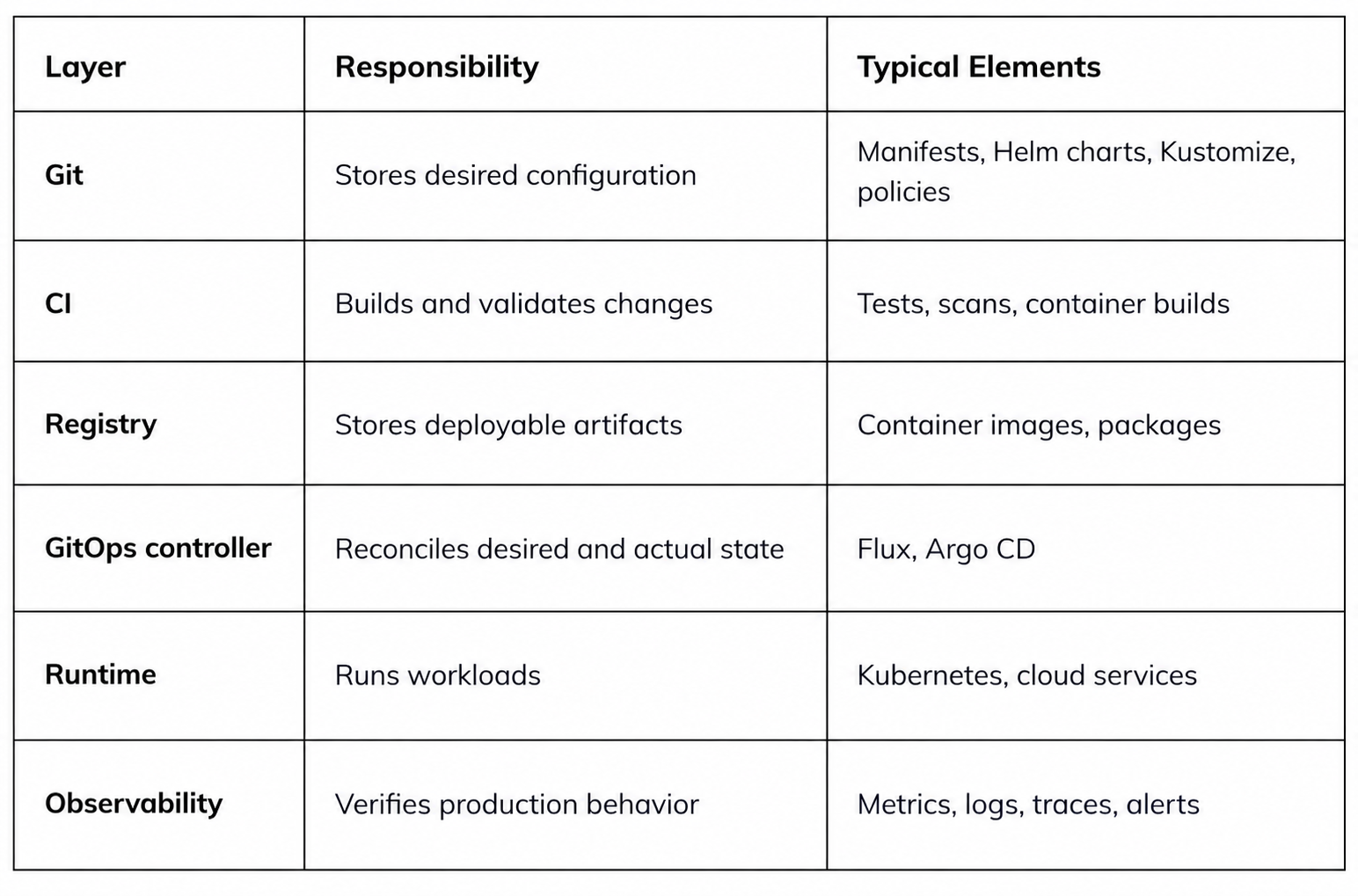
The critical architectural decision is where deployment authority lives. In a conventional push-based pipeline, the CI system connects to the production environment and executes deployment commands. This often requires the CI platform to hold powerful production credentials. In a pull-based GitOps architecture, a controller running inside or alongside the target environment retrieves approved configuration from Git and reconciles it with the runtime. This creates a clearer separation of responsibilities: CI produces and validates artifacts, Git records the approved state, and the GitOps controller manages deployment reconciliation.
A well-designed GitOps workflow separates application delivery from production state management.
A typical change follows this process:
Repository structure should reflect team ownership, security boundaries, deployment frequency, and the number of services and environments being managed. At enterprise scale, repository design becomes an architectural decision rather than a naming convention. A model that works for five services may become difficult to govern across hundreds of workloads and multiple platform teams.
GitOps does not replace CI/CD. It changes how the deployment side of the delivery process is controlled.
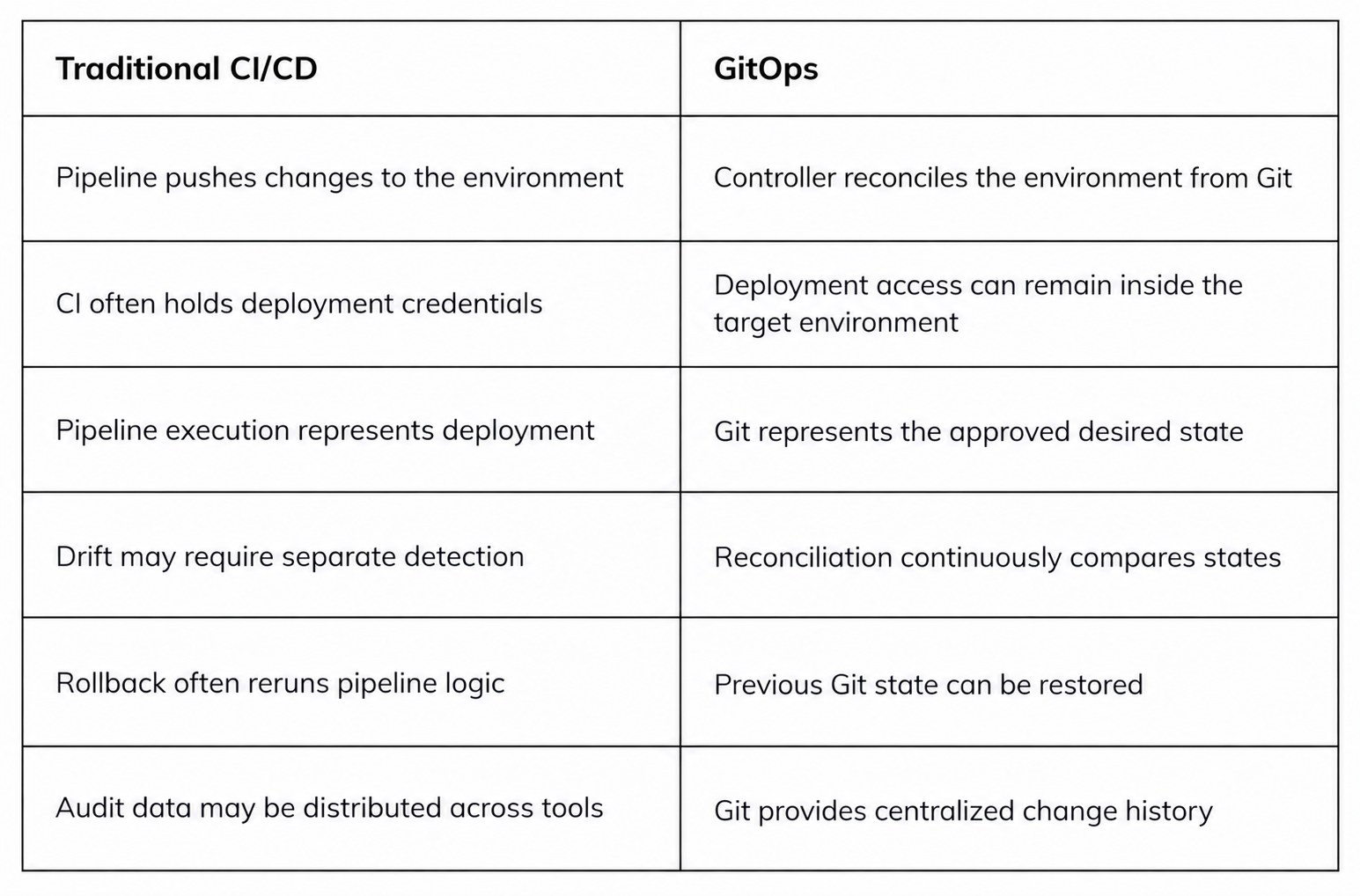
In practice, the strongest architecture often combines both. CI remains responsible for building, testing, scanning, and publishing artifacts. GitOps controls what should run in each environment and continuously reconciles that state. OpsWorks CI/CD implementation focuses on creating automated, repeatable delivery workflows. GitOps becomes a logical next layer when deployment complexity begins to exceed what pipeline scripts alone can manage reliably.
GitOps and Infrastructure as Code solve related but different problems. IaC defines infrastructure in machine-readable configuration and makes provisioning reproducible. GitOps defines an operating model for managing approved state through Git and automated reconciliation. Terraform, for example, may define cloud networks, Kubernetes clusters, IAM resources, and databases. GitOps can manage application configuration and Kubernetes resources running on top of that foundation.
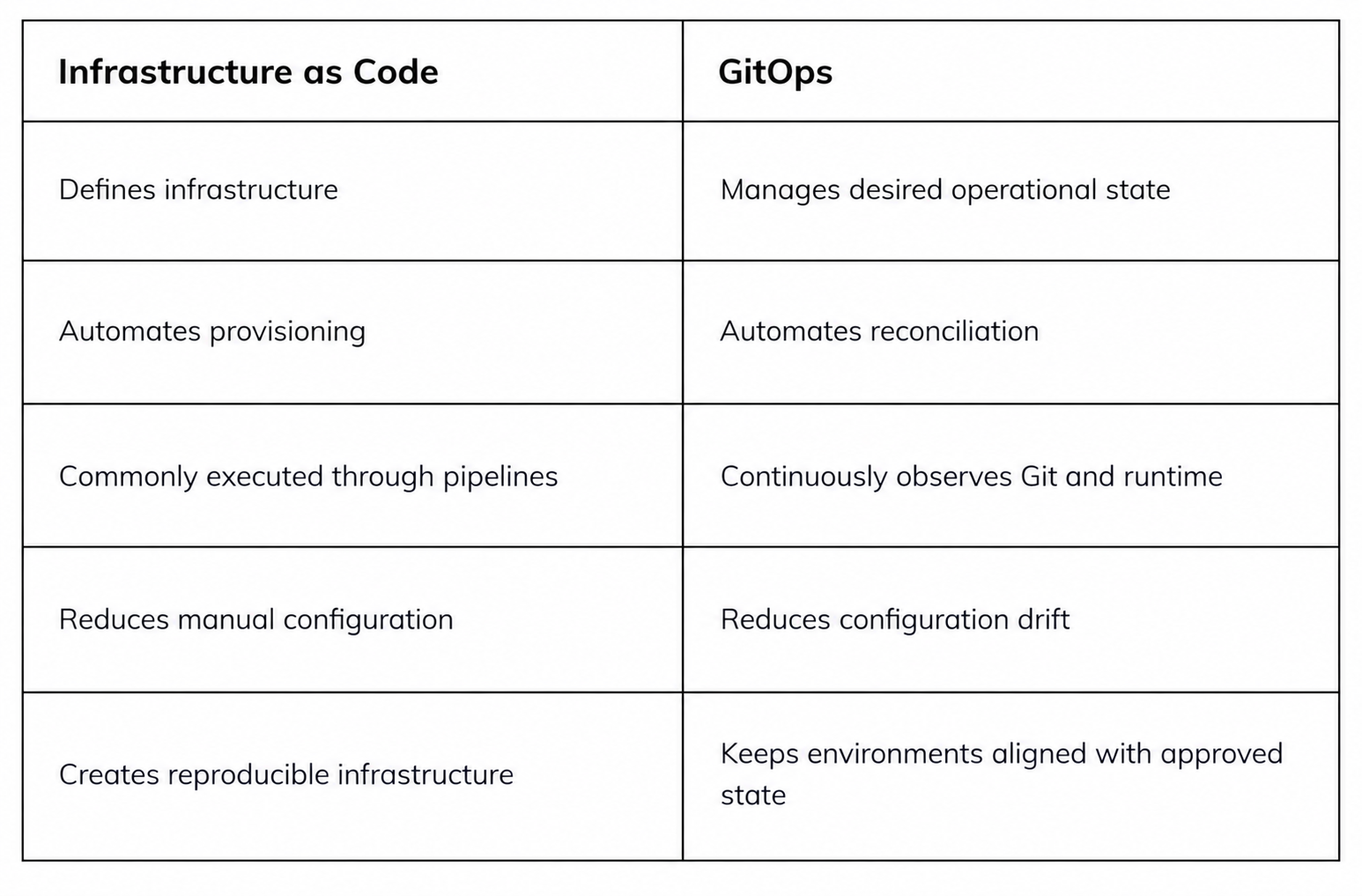
The exact boundary depends on the environment. What matters is preventing multiple automation systems from competing to control the same resource. Every resource should have a clearly defined source of truth and reconciliation mechanism. For organizations still struggling with inconsistent provisioning, IaC implementation is usually a more fundamental step. GitOps works best when declarative infrastructure practices are already established.
Kubernetes is particularly well suited to GitOps because it already relies on declarative configuration and continuous reconciliation. GitOps extends this model by storing the approved configuration in Git and using controllers to reconcile it with Kubernetes environments.
GitOps Kubernetes workflows can manage:
The value increases as an enterprise moves from one Kubernetes cluster to many. Instead of maintaining deployment scripts and procedures for every cluster, teams can establish reusable patterns for workloads, environments, and platform services. But GitOps cannot compensate for poor Kubernetes architecture. If cluster ownership, networking, resource policies, secrets, and observability are inconsistent, automation can simply reproduce those inconsistencies faster.
GitOps tools should be selected around operating requirements rather than feature lists. For Kubernetes environments, Argo CD and Flux are two established options. Both support declarative, Git-driven continuous delivery, but they differ in how teams interact with and extend them.
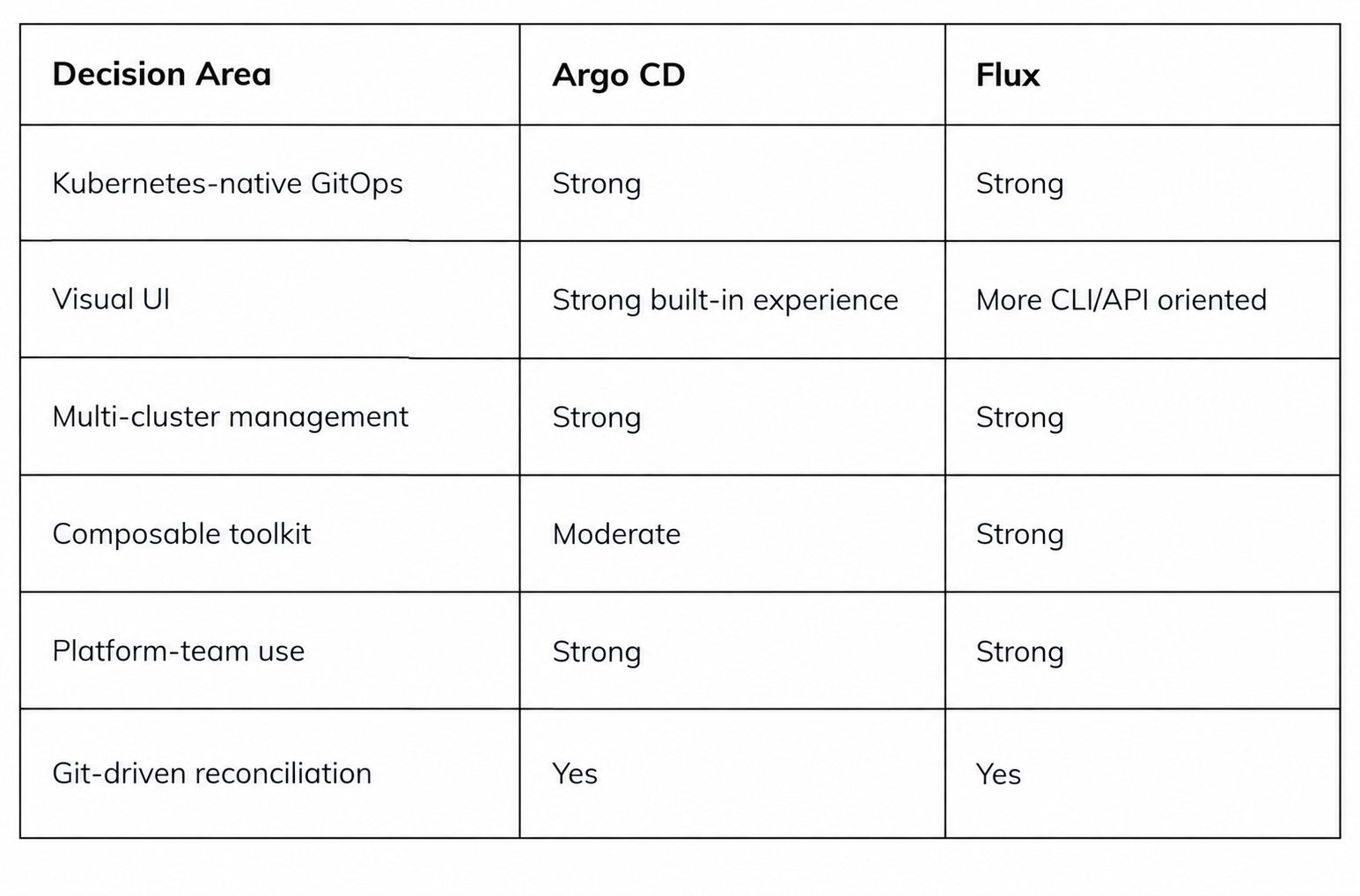
The tool itself is rarely the hardest part. Repository architecture, access control, environment promotion, secret handling, rollback strategy, observability, and ownership determine whether the implementation remains manageable after the first few clusters. OpsWorks includes Enterprise FluxCD Management within its DevOps Transformation offering, alongside orchestration, CI/CD, and IaC implementation. This is particularly relevant when the requirement extends beyond installing a controller to operating GitOps reliably across enterprise infrastructure.
Not every infrastructure problem requires GitOps. Before implementing it, identify the operational problem you are trying to solve.
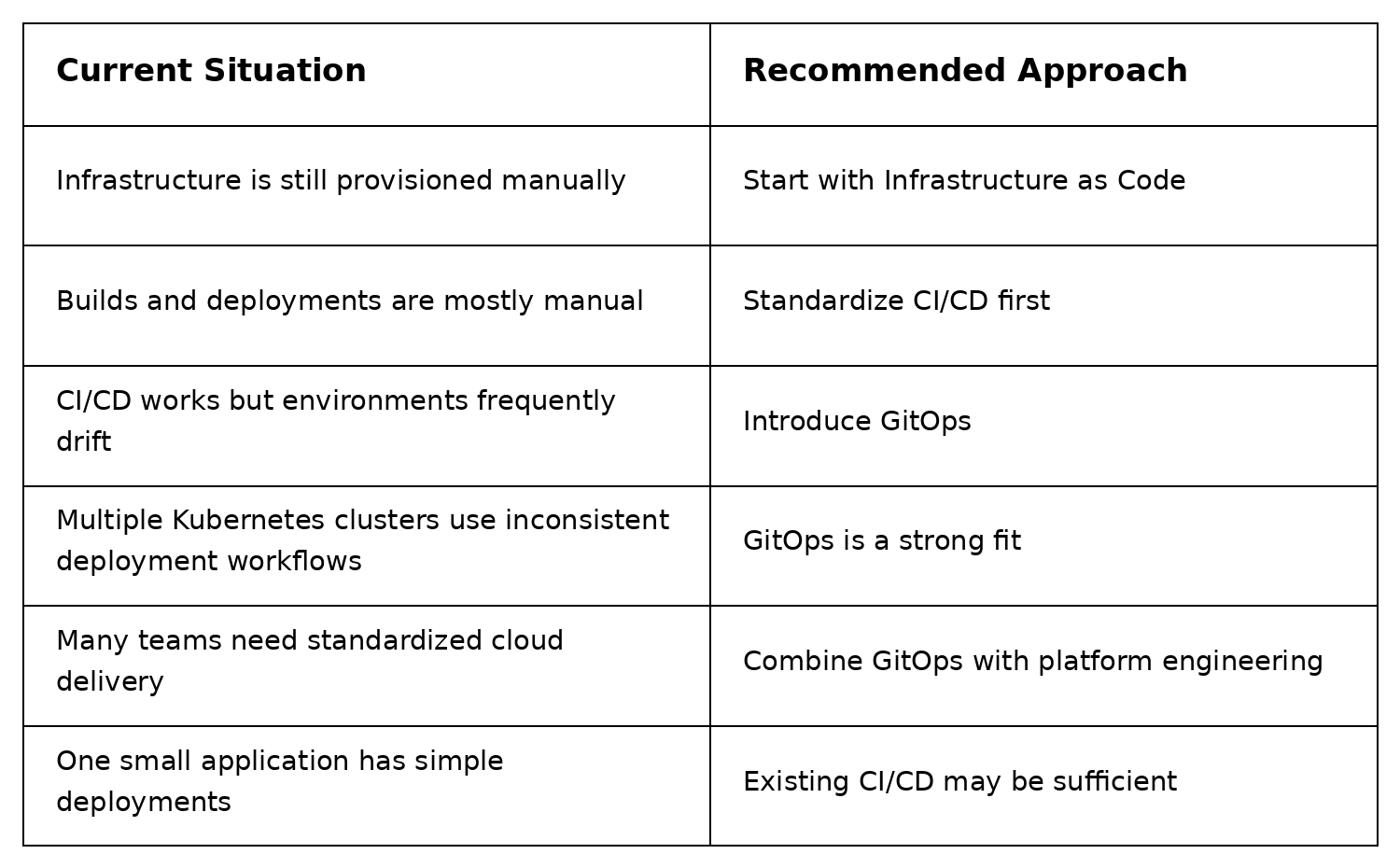
A useful rule is this: GitOps becomes valuable when deployment automation exists, but controlling deployment state across environments becomes the harder problem. For organizations unsure where that boundary lies, a DevOps assessment can identify whether the immediate bottleneck is CI/CD, infrastructure provisioning, Kubernetes operations, GitOps, or the broader platform architecture.
Successful GitOps implementation starts with operating standards rather than installing a tool.
Map how changes currently reach production. Identify who approves them, where deployment credentials live, which systems can modify production, how environments differ, and what happens when deployment fails. Pay particular attention to configuration and manual actions that exist outside version control. These are often the first sources of drift that GitOps needs to eliminate.
Decide which system owns each type of configuration. Application code, artifacts, infrastructure definitions, deployment manifests, secrets, and policies should have explicit ownership. Avoid allowing the same production resource to be modified through several independent paths. The more ways an environment can change outside the declared workflow, the less reliable GitOps reconciliation becomes.
Do not migrate every workload at once. Start with one representative service and validate repository structure, CI integration, artifact management, GitOps deployment, rollback, secrets, observability, and access control. Once the full workflow works under real production conditions, turn those decisions into a repeatable pattern.
Define conventions for repository structure, environment promotion, Helm or Kustomize usage, RBAC, secret management, policy checks, rollback, and monitoring. This is where GitOps begins to connect with platform engineering. As explained in Where DevOps Ends and Platform Engineering Begins, platform teams can turn GitOps, Kubernetes, CI/CD, and other operational capabilities into reusable workflows instead of requiring every application team to build them independently.
At enterprise scale, developers should not need to understand every component of the GitOps architecture to deploy safely. Platform teams can expose approved workflows through templates, golden paths, service catalogs, or an internal developer platform. The OpsWorks guide to Internal Developer Platforms explains how GitOps, CI/CD, IaC, Kubernetes, observability, and security controls can work together behind standardized self-service workflows. At that point, GitOps becomes infrastructure behind the developer experience rather than another tool every engineer must operate.
The quality of the operating model matters more than the amount of automation.
If engineers routinely bypass Git and change production manually, GitOps loses much of its value. Emergency access may still be necessary, but out-of-band changes should be detected and reconciled rather than becoming permanent undocumented state.
CI should produce a tested and validated artifact. GitOps should control where and how the approved artifact is deployed. This separation reduces coupling between build systems and production infrastructure and limits the credentials CI needs to hold.
GitOps improves traceability, but version control alone does not make a deployment secure. Do not store plaintext secrets in Git. Apply least-privilege access, branch protection, appropriate secret management, policy validation, controlled production permissions, and signed changes where required.
A Git revert does not automatically make every rollback safe. Database migrations, stateful workloads, external dependencies, and incompatible schema changes require explicit recovery strategies. Rollback should therefore be tested as part of the deployment architecture rather than assumed to work because previous configuration exists in Git.
Application health is only part of GitOps observability. Monitor controller health, reconciliation failures, configuration drift, deployment duration, failed promotions, and differences between desired and actual state. A healthy application can still be running on an unhealthy delivery process.
GitOps implementations usually fail because of operating-model problems rather than controller limitations. Common issues include automating inconsistent deployment practices, adopting Argo CD or Flux before defining ownership and governance, and hiding too much operational complexity behind abstractions. GitOps also changes who can modify production, how changes are approved, and where operational state is defined. These decisions require agreement across development, platform, operations, and security teams. A technically successful GitOps deployment without clear ownership can simply replace one form of operational complexity with another.
These approaches solve different layers of the delivery problem. GitOps controls desired application and infrastructure state. Platform engineering turns capabilities such as GitOps, IaC, CI/CD, Kubernetes, and observability into standardized services. An internal developer platform can expose those services through self-service workflows. As organizations scale, GitOps can therefore become an infrastructure capability behind the developer platform rather than another tool every developer must manage. This distinction matters because introducing an IDP before the underlying delivery workflows are standardized tends to hide complexity rather than remove it.
GitOps should improve delivery outcomes, not simply increase the number of repositories or clusters under automation.
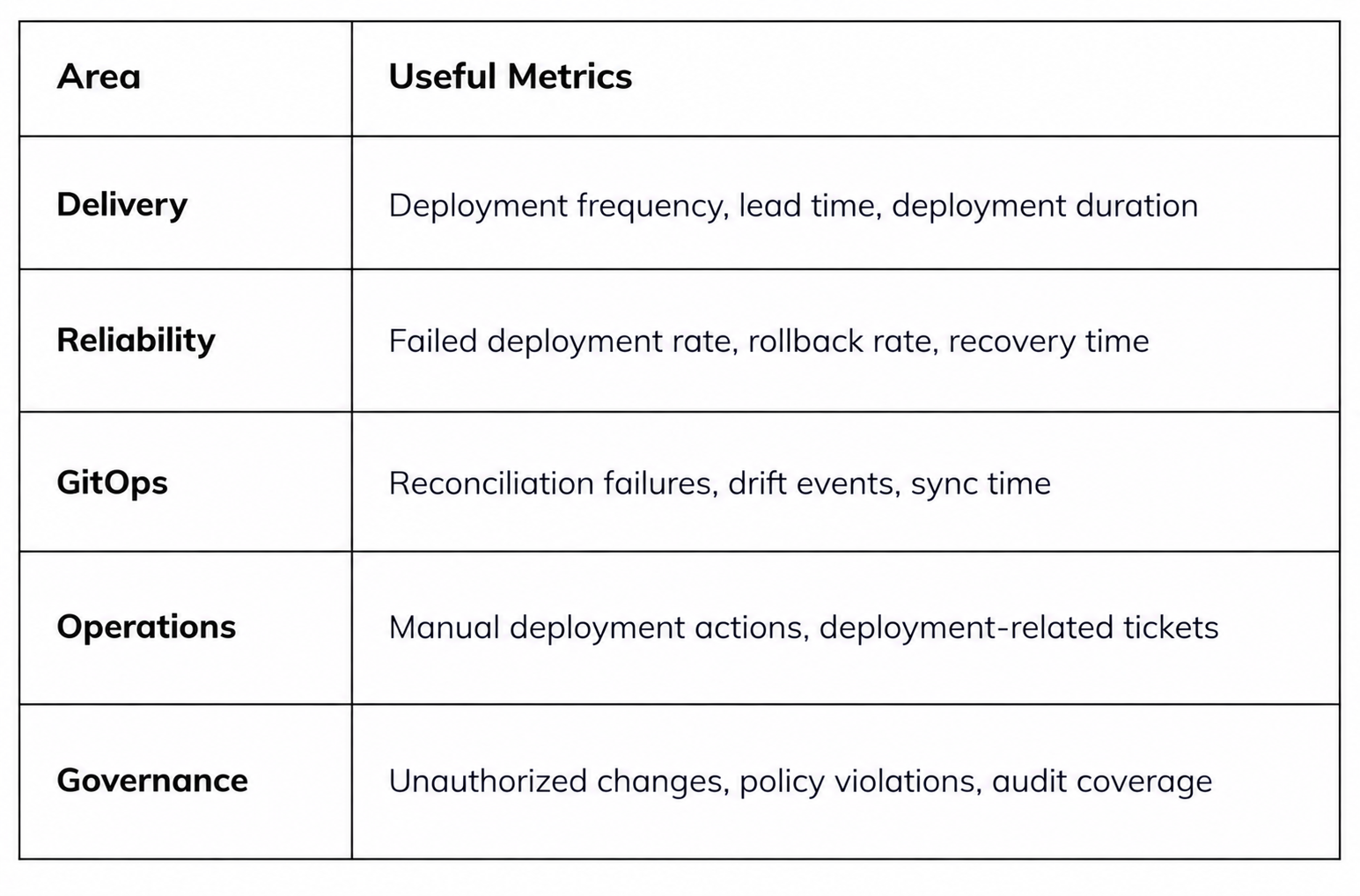
Compare these metrics before and after GitOps adoption. If deployment automation increases but incidents, operational toil, and recovery time do not improve, the organization has automated activity rather than improved delivery.
GitOps becomes valuable when organizations outgrow deployment automation based on scripts, manual production access, and environment-specific pipeline logic. The goal is not to put YAML in Git. It is to make cloud infrastructure predictable: changes are reviewable, environments reproducible, drift detectable, and recovery repeatable. Getting there requires more than installing a GitOps tool. IaC, CI/CD, Kubernetes architecture, security, observability, and operating standards need to work together. OpsWorks DevOps Transformation services cover these foundations, from DevOps assessment, CI/CD and IaC implementation to orchestration and Enterprise FluxCD Management. For teams moving toward GitOps at scale, the first step is determining what needs to be standardized before it is automated.
GitOps is an operating model in which the desired state of applications and infrastructure is defined declaratively, versioned in Git, and automatically reconciled with running environments. Git acts as the auditable source of truth for approved configuration.
No. CI/CD covers the broader build, test, and delivery lifecycle. GitOps focuses on controlling and reconciling desired deployment state. A common architecture uses CI to build and test artifacts and GitOps to deploy and reconcile them.
No. GitOps principles can be applied outside Kubernetes, but Kubernetes is particularly well suited to GitOps because both rely on declarative configuration and reconciliation.
Argo CD and Flux are two established Kubernetes GitOps tools. The right choice depends on platform architecture, multi-cluster requirements, integrations, governance, developer experience, and operational ownership.
GitOps is a strong fit when an organization already uses CI/CD and declarative infrastructure but faces configuration drift, inconsistent deployment workflows, multiple Kubernetes clusters, complex environment promotion, or increasing production governance requirements.


Subscribe to our newsletter and get the latest insights that help you stay ahead of the curve.

© 2017-2025 All rights are reserved


